Signs your child is ready to ditch diapers: how to tell if they are ready
Transparency: Adiós Pañal is made by AppRadar, the publisher of this website.

Adiós PañalPotty Training
Signs of readiness for potty training include noticing the need or wetness, showing interest in the bathroom, and participating in sitting and dressing routines. Readiness combines physical abilities, understanding, and willingness; a birthday alone does not determine when to start.
Physical signs you can observe
A diaper that remains dry for a noticeable period may indicate a change in pattern, but it alone does not prove that the child has control over when to urinate. Observe whether the child notices when they are wet, if they pause or change their movements before defecating, and if they can reach the potty with help. The AAP lists signs such as recognizing wet and dry, sensing the urge, and participating in dressing. They don't need to master all the steps independently from the first try.
Some children can communicate with a word, a gesture, or a look. If verbal expression is still developing, accept whatever form they are able to use and teach simple vocabulary: pee, poo, dry, potty, and handwashing. Don't interpret an accident as a complete lack of preparedness. Attention to play, difficulty pulling down pants, or an unfamiliar bathroom can all be contributing factors. Look for a pattern of recurring signs on different days, not just a snapshot of one morning.
Interest and emotional disposition
A child may accompany an adult to the bathroom, ask for a potty, imitate the routine, or be happy to try it. They may also show interest one week and rejection the next. Emotional readiness cannot be forced with a schedule. Offer small choices: choosing between a potty and a toilet seat adapter, selecting a short story, or deciding what comfortable clothes to wear. If this leads to frequent struggles, reduce the pressure and return to a preparation stage.
The AAP explains that emotional development can vary throughout this stage. A reward can celebrate an attempt, but it shouldn't force the child to urinate or defecate. If the child sits down and nothing happens, thank them for trying. The Adiós Pañal app recognizes attempts and allows you to choose experiences as rewards. Use it to record positive support, not to turn the body into a points-based goal. Pay special attention to the child's response to prompts.
Understanding the bathroom sequence
Feeling the need is only one step. There's also the need to stop playing, locate the bathroom, get there, manage clothing, sit down, clean with help, and wash hands. Teach this sequence in stages. A visual routine or story can help anticipate what will happen, but it's not proof that they'll do it alone. The large buttons and voice-guided routine in kid mode of Adiós Pañal are described in the iOS listing. An adult should still be present for hygiene and safety.

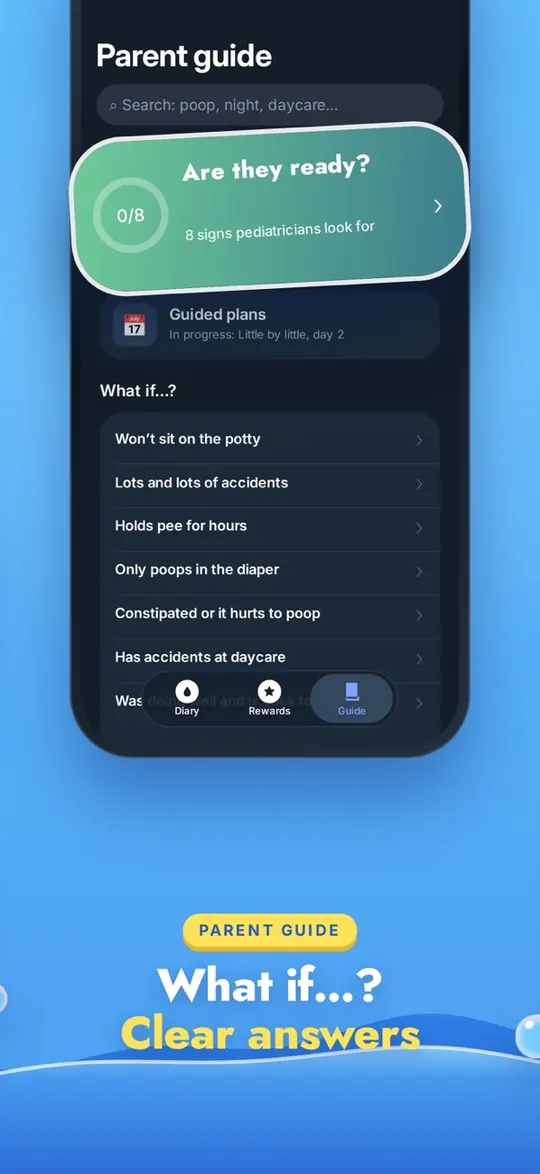
Try a quiet moment without asking for a result. Show them where the toilet paper is stored and how to flush; avoid startling them with the toilet if they are afraid. If they understand the sequence but refuse to sit down, their understanding and readiness are not yet aligned. You can continue familiarizing them with the process. If they sit down happily but don't recognize the sensation before defecating, this learning may take more time. Breaking down skills prevents labeling the child as either ready or unready in a blanket way.
Signals matter more than a date
The decision to start potty training doesn't depend on your child turning exactly two or three years old. Observe whether your child notices wetness or the need to urinate or defecate, shows curiosity about the bathroom, can participate in lowering their clothes, and is willing to sit for a few moments without distress. Some signs appear earlier than others, and it's not a test that should be passed in a day. The American Academy of Pediatrics describes readiness as a combination of physical development, understanding, and emotional readiness. Talk to your pediatrician if you have any particular needs or concerns about your child's development.
The Spanish Association of Pediatrics explains that toilet training is usually established around two to three years of age, with individual variation. This age is a general guideline, not a strict deadline. Using simple words, showing the child where the potty is, and allowing them to observe the routine can precede any potty training. If the child responds with strong resistance, returning to a familiarization phase may be more helpful than increasing the frequency of reminders. Technology does not create a physical skill that is still developing.
Accidents, rewards and respect
An accident provides information about the moment, the context, and the available clothing. It's not a moral failing. Clean up calmly, offer a change of clothes, and continue with the routine without taking away rewards already earned. The Adiós Pañal app listing explicitly states that accidents don't deduct stars and that every attempt counts. Their system offers experience rewards chosen by the family, such as selecting a storybook or going to the park. This choice allows them to celebrate the effort without turning toilet learning into a competition for objects.
HealthyChildren, from the American Academy of Pediatrics, explains that daytime accidents can continue for months even after apparent progress. If they are very frequent, do not decrease, or are accompanied by discomfort, it is advisable to consult a pediatrician. Do not force the child to sit for long periods or punish them for wet clothes. Ask if they want to try, offer help, and pay attention to their response. A chart may show patterns, but a graph does not define a child's worth or replace observing how they feel.
What to do if your child does not seem ready yet
Keep the potty visible, read a story about using the toilet, encourage them to name sensations, and allow them to choose easy-to-manage clothing. Don't announce that they will be potty trained in three days if there aren't enough signs. You can observe for several weeks and ask again. Talk to the school to find out what they see in their environment. A pause is not a failure and doesn't erase what they've learned.
If there is a developmental condition, mobility difficulty, pain, or constipation, ask professionals and caregivers for tailored guidance. The AAP emphasizes that some children need different support and timelines. An app can record information, but it is not a substitute for an individual assessment. Adjust the potty, instructions, and environment to suit their situation. Autonomy includes being able to express discomfort and receive help, not just being able to meet a specific age requirement.
How to use a record without turning it into an exam
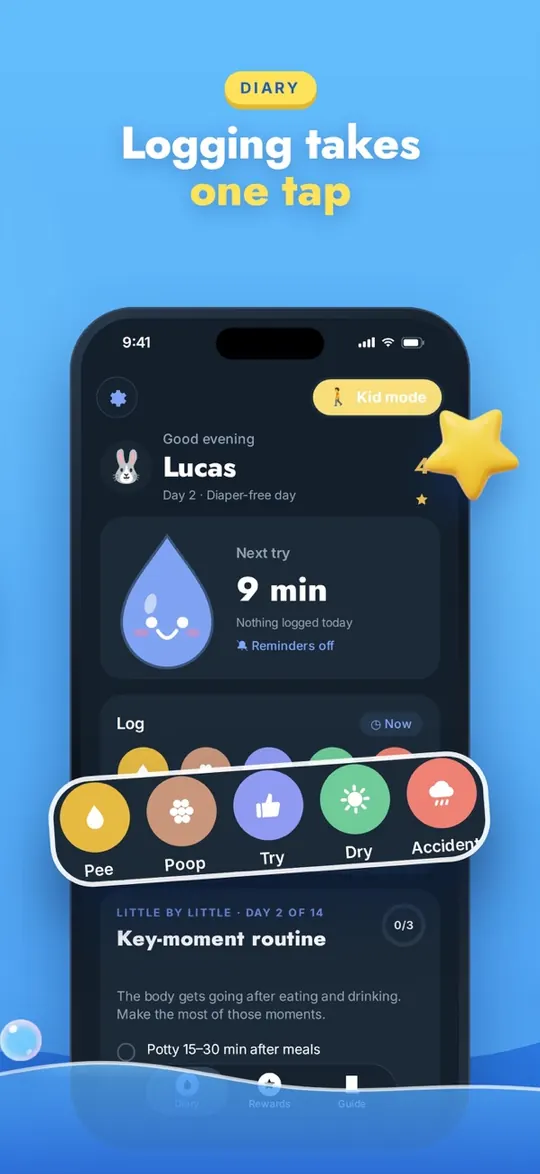
Simply note pee, poop, attempt, dry, or accident if it helps you recognize regular moments. You don't need to record every minute of the day. Droplet, the character from Adiós Pañal, adjusts alerts based on the data entered; if events are missing, the suggestion may not reflect reality. Look for general patterns and listen to your child when they need to go, even if the screen hasn't anticipated it. You can also disable or change a reminder that is too intrusive.
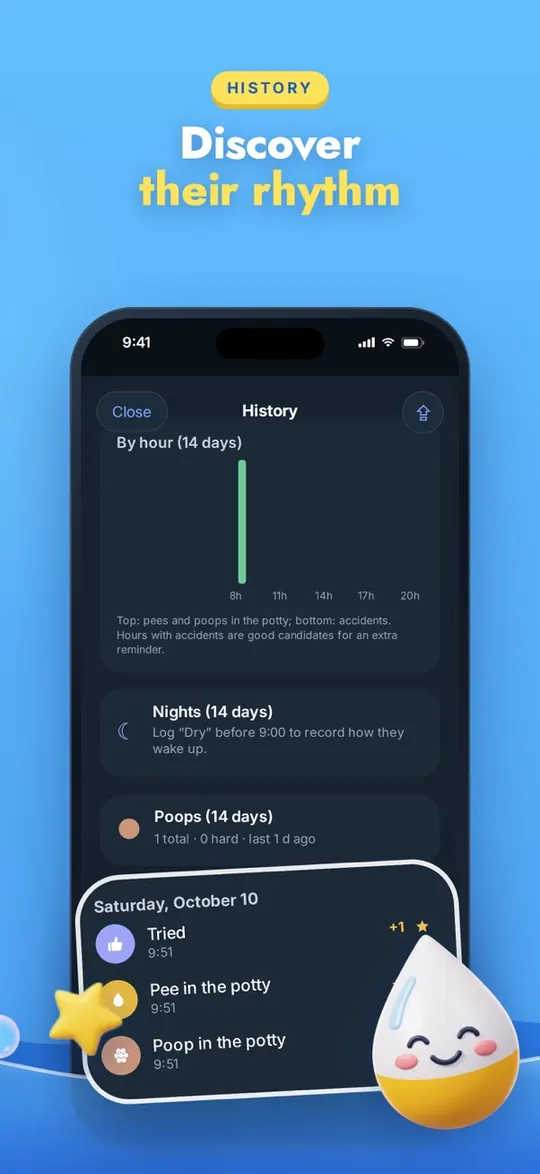
The log can help explain a specific concern to the pediatrician: when the pain started, how often the child has bowel movements, or what happened when the routine changed. Don't use a string of dry days as a diagnosis. The app listing announces a PDF report within Plus; a readable summary is helpful for conversation, but requires context and professional review. Keep the child's data private and share only what's necessary.
Poop, constipation and consultation
Learning to pee and learning to poop don't always progress at the same pace. Some children ask for a diaper to poop, become tense, or try to hold it in. Pain and constipation can complicate the experience; an app that alerts more often won't solve the problem. Consult your pediatrician if there is pain, hard stools, retention, blood, persistent discomfort, or concern about bowel habits. Describe what is happening and when it started, rather than trying to impose a deadline.
The AAP notes that constipation can occur during this stage and recommends individualized guidance for its treatment. Specific advice on continuing, pausing, or modifying training depends on the symptoms and a professional assessment; it should not be reduced to a one-size-fits-all rule found online. If you keep a record of urination, defecation, and attempts, you can show a helpful summary during a consultation. Adiós Pañal advertises a PDF report for the pediatrician within Plus, but the report does not provide a diagnosis.
What the app does and what it doesn't promise
The App Store listing presents Adiós Pañal as a tool to help track pee, poop, attempts, dry moments, and accidents with a single tap. It describes reminders that count again after each pee and adjust to the recorded rate, seven-day preparation and fourteen-day gradual plans, a kid mode with large buttons, stories and stickers, and a caregiver card. Check the exact availability of each feature and its language in your app store. The Android download link is provided, but the features listed here are from the iOS listing.
An app cannot tell if a child is ready just by the time between two check-ins. Entries may be incomplete when caring for others, during an outing, or at night. Use the reminder suggestion as a flexible prompt, not as an order to sit down a resisting child. If the schedule changes due to illness, vacation, or school, adjust the plan. The goal is to help the family share a consistent routine while the child becomes more independent at their own pace.
Privacy, access and paid version
The iOS listing states that no account is needed, no ads are displayed, and data is stored on the device. Apple clarifies that the privacy information is declared by the developer and is not independently verified. Avoid sharing screenshots with the child's name, schedules, and other data on public networks. If you change phones, check beforehand how the history is stored. The caregiver card can be helpful, but only share what is necessary with the people involved.
Adiós Pañal is a free download with in-app purchases. The listing describes Plus as a one-time payment, without a subscription, that adds the three-day intensive plan, the dry nights plan, more comprehensive guides and reports, multiple siblings, and additional content. Don't interpret "three-day plan" as a promise to eliminate diapers within that timeframe. Prices and content may vary by store and date. Before paying, try the basic tools and decide if the expanded material meets a real need for your family.
Frequently Asked Questions
Is being dry for two hours enough?
It is one possible signal among several; perception, participation, and disposition also matter.
Does my child need to ask to use the toilet with words?
Children can communicate with gestures while learning the words.
What if my child is interested in the potty but doesn't go?
Getting familiar with it is also a step; avoid forcing it.
Is the age of two mandatory?
No. There is individual variation and it is advisable to observe the child.
Does the app determine whether my child is ready?
No. It provides records and guidance, but does not clinically assess readiness.
Sources and criteria
App features according to the official Adiós Pañal listing on the App Store. For development and preparation, consult the Spanish Association of Pediatrics and the American Academy of Pediatrics. Regarding accidents and constipation, the HealthyChildren guides offer general guidance. Check dates, conditions, and language for each listing; this guide is not a substitute for a pediatric evaluation.