Learning to subtract: how to explain taking away and going back without rushing
Transparency: Numerana is made by AppRadar, the publisher of this website.

CroakulatorAdd & Subtract
On Google Play this app is listed as “Croakulator: Add & Subtract”; this guide calls it Numerana, the name used in the store description.
Learning to subtract begins with recognizing an initial quantity and observing what remains when a part is removed. This can be represented with objects, drawings, and stepping back; then, this action is connected to the minus sign.
Remove something that was present
Place five objects in plain sight and remove two while the child watches. Ask how many there were, how many were removed, and how many remain. Put the five back together and let the child perform the action. This scenario helps children understand 5 − 2 = 3 better than asking for an answer without context. If they recount the remaining three, they are using a valid strategy. They can then anticipate the outcome before removing the objects and check their answer.

Go back on the number line
Place a marker on seven and take three jumps backward: six, five, and four. Just like when adding, don't count the starting position as a jump. Mark each movement and then write 7 − 3 = 4. The number line makes it clear that subtracting a positive quantity leads to a smaller number within these examples. Use an actual row of cards on the floor if the screen seems too abstract.
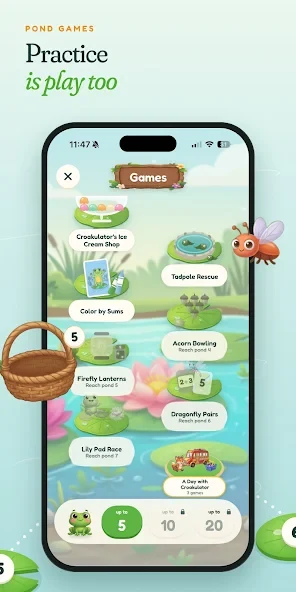
The water lilies in Numerana represent those steps. Once the action is understood, ask if one can also think, "How much is left from four to seven?" This counting forward is another strategy for finding a difference. Don't introduce it before the first one is clear. The What Works Clearinghouse advises connecting physical paths, drawings, and formal number lines, explaining what each unit represents and the position of zero.

Two different questions with the same calculation
“I had eight cookies and ate three” asks about what’s left. “I have five and I need eight” asks how much is missing. Both can be related to subtraction, but they require interpreting different stories. Draw each situation and ask what information the child knows and what they are looking for. If they confuse the sign because they hear the word “plus” in a comparison statement, have them redraw quantities. The language of the problem is just as important as doing the calculations.
The What Works Clearinghouse guide suggests deliberately teaching word problems. Numerana announces problems told by Rana; use the voice to pause and ask, "What happened in the story?" Don't let the child tap an answer simply by recognizing keywords. Sometimes two quantities need to be compared without anything physically being taken away. Subtraction can also express the distance between them, something worth exploring with two-colored blocks.
From objects to drawings and symbols
A sum written as 4 + 3 = 7 condenses many ideas: four objects, three being added, a final quantity, and a symbol that expresses equality. As a first approach, the child can move objects, count them, and then draw what they have done. Later, they recognize the written operation without always needing the physical objects. The Education Endowment Foundation recommends making the relationship between manipulatives, representations, and symbols explicit. Using a ladybug or a water lily does not, in itself, guarantee understanding; it is important to ask what it represents and why the quantity changed.
At home, accompany the process with a brief question: "What did you do first, and what changed?" If the child responds with their fingers, a drawing, or their own words, listen to their strategy before correcting them. Don't remove visual support to meet a deadline; use it when it helps and gradually simplify it as the child learns to explain the concept.
How to interpret errors and clues
An incorrect answer reveals whether the child has counted an extra jump, confused the sign, or misunderstood the problem. Avoid correcting only the final number. Ask them to show their method using objects, fingers, or a number line. The What Works Clearinghouse guidelines recommend systematic instruction, clear mathematical language, and well-chosen representations, especially when difficulties arise. This requires observing the reasoning, not just the score display.
The relationship between addition and subtraction
If 4 + 3 = 7, then 7 − 3 = 4. Form two groups of objects and join them together; then separate one. This relationship helps to check results and reduces the feeling that addition and subtraction are independent lists of answers. Let the child act out and undo the scene. Later, an unknown number can be posed as "4 + how much? = 7". The concrete representation allows the problem to be solved without immediately memorizing a rule.
Pairs that reach ten and doubles also help with subtraction. If you know that 6 + 4 = 10, you can reason that 10 − 4 = 6. Memorizing results is useful when supported by understood relationships. Numerana's Lotus Garden promises to review addition; it asks what subtraction strategies each remembered result allows. An app should not replace the ability to explain, check, and correct.
Subtraction with tens and regrouping
For 32 − 10, note that three tens and two ones become two tens and two ones. In 32 − 5, the child may need to separate one ten into ten ones. Use a bundle of tens and loose ones to show the exchange before writing a column. Saying "borrow one" without showing which group is broken up can lead to a poorly understood recipe. Repeat with smaller numbers and ask if the answer is reasonable: 32 − 5 should end up close to 32 and below.
Numerana introduces tens, units, the hundred chart, and operations up to one hundred. These are contents of the described learning path, not a goal that everyone must reach in a week. The table can show that moving one row changes ten and moving one square changes one, depending on how it is organized. Relate the table to bunches of reeds to avoid each resource being a disconnected activity. If a systematic error appears in the column, return to the specific grouping.
A short exercise that can go off-screen
A digital activity only makes sense when the child recognizes the same concept on the table. Place five pieces, add two, and count how many there are now. Remove three and ask what has changed. If they still need to point to them one by one, they are building a strategy; don't demand instant mental calculation. On a walk, you can count steps, two-colored cars, or flowerpots. The educational recommendation is not to turn every moment into a test, but to provide opportunities to use numbers meaningfully.
Frequently Asked Questions
What is the first way to explain subtraction?
Remove some objects from a known quantity and count what remains.
Do you always subtract by walking backwards?
No; you can also find out how much is missing or compare two quantities.
What does 7 − 3 mean?
Depending on the context, subtract three from seven or find a difference of three units.
When should you teach the column method?
When tens and units and their exchanges make sense with objects and drawings.
Does an error indicate that they don't know how to subtract?
No; it helps to identify the step that needs another representation or explanation.
Sources and scope
For teaching early mathematics: What Works Clearinghouse on Early Childhood and Primary Intervention; for concrete representations and drawings: Education Endowment Foundation.