Best apps for learning addition and subtraction: 4 options compared
Transparency: Numerana is made by AppRadar, the publisher of this website.

CroakulatorAdd & Subtract
On Google Play this app is listed as “Croakulator: Add & Subtract”; this guide calls it Numerana, the name used in the store description.
The best apps for learning addition and subtraction are those that explain the quantities before asking for quick answers.
Criteria for ordering the ranking
I evaluated whether the app explains before asking questions, how it represents quantities and symbols, what happens after an error, the progression from counting to more complex operations, family access, and transparency regarding purchases. The first-place app specifically aims to teach addition and subtraction with a step-by-step approach. This is not a comparative study, nor does it claim that children learn more with Numerana than with any of the other three apps.
Before installing, check the suggested age, language, family controls, privacy settings, and what parts are available for free. The number of activities doesn't always indicate how much support each one offers. Ask the child what they did to solve an example and repeat a similar activity with real objects. A program can be engaging and still require adult discussion. Educational guides recommend connecting concrete representations, drawings, and symbols, and teaching systematically, not relying on the screen alone to produce understanding.
1. Numerana: addition and subtraction with a frog that demonstrates the method
Rana first demonstrates the exercise aloud, gives a hint after a mistake, and then shows the solution. Water lilies, ladybirds, flies, and bunches of rushes represent the number line, addition, subtraction, and tens. The lotus garden reviews facts the child finds difficult. It is the first resource for those seeking a specific path for addition and subtraction with visual scaffolding and without a clock.
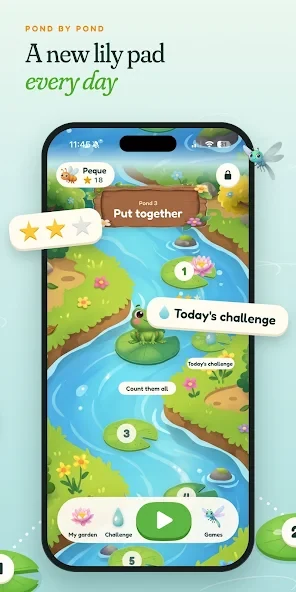
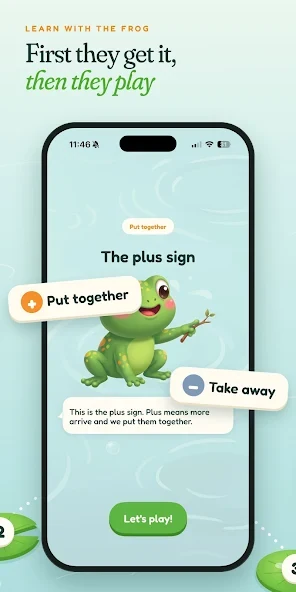
The first pond and one initial lily pad in each pond are advertised for free; Numerana Familia offers the rest with monthly, annual, and one-time payment plans. The description also promises four profiles, family progress tracking, PDF fact sheets, and no ads. Google Play.
2. Khan Academy Kids: a broad and free option
Khan Academy Kids offers counting, addition, subtraction, reading, and other areas for early childhood education. Its official website presents the app as free and ad-free. On Google Play, it describes a variety of games, stories, and activities. It may be the best choice if the family wants a single app for math and literacy, especially when the budget requires a completely free option. Official Khan Academy Kids page.
This breadth also means that the child can alternate between areas and not always follow a single course focused on addition and subtraction. Check if the language, specific activities, and level suit their needs. Numerana ranks higher in this list because of its specific math sequence with spoken demonstrations by Rana, not because the free resource is lacking. If your main goal is to explore multiple subjects without paying, your personal ranking might put Khan Academy Kids first.
From objects to drawings and symbols
A sum written as 4 + 3 = 7 condenses many ideas: four objects, three being added, a final quantity, and a symbol that expresses equality. As a first approach, the child can move objects, count them, and then draw what they have done. Later, they recognize the written operation without always needing the physical objects. The Education Endowment Foundation recommends making the relationship between manipulatives, representations, and symbols explicit. Using a ladybird or a water lily does not, in itself, guarantee understanding; it is important to ask what it represents and why the quantity changed.
At home, accompany the process with a brief question: "What did you do first, and what changed?" If the child responds with their fingers, a drawing, or their own words, listen to their strategy before correcting them. Don't remove visual support to meet a deadline; use it when it helps and gradually simplify it as the child learns to explain the concept.
How to interpret errors and clues
An incorrect answer reveals whether the child has counted an extra jump, confused the sign, or misunderstood the problem. Avoid correcting only the final number. Ask them to show their method using objects, fingers, or a number line. The What Works Clearinghouse guidelines recommend systematic instruction, clear mathematical language, and well-chosen representations, especially when difficulties arise. This requires observing the reasoning, not just the score display.
3. Todo Math: an extensive mathematical catalog
Todo Math presents thousands of activities on its Google Play page, ranging from counting and calculation to geometry, calendars, and other content. It describes levels that begin with counting to ten and progress to multi-digit operations. It has a family section to track progress and offers a free trial, as well as email registration, according to the listing. It might be suitable if you're looking for a variety of topics and level settings. Official Todo Math listing.
A very broad offering requires checking how much the child can use without subscribing and what account type they require in the current version. Don't assign ads or a specific price without checking your store. In this ranking, it comes in third because its focus is a concrete explanation of addition and subtraction, from objects to symbols. If your child already understands these concepts and wants to learn geometry or more advanced topics, Todo Math might be more suitable. Watch a real game and ask if they understand why an answer is correct.
4. Moose Math: Games and Rewards
Moose Math, by Duck Duck Moose, describes five activities including counting, addition, subtraction, sorting, and geometry. It offers games with dice and abacuses, addition and subtraction up to twenty, rewards for building a city, and an adult report card. It may appeal to those who prefer a more open-ended play environment and early learning activities. Official Moose Math listing.
Its advertised range of addition and subtraction up to twenty is less than the range up to one hundred described for Numerana. That doesn't make it any less suitable for a child who is still counting: a narrower focus may be appropriate. Check the voice language, access model, and design on your device. The fourth position reflects the criterion of continuity up to two-digit operations, not a judgment on its fun factor or overall quality. The visual rewards are an invitation to play; the adult can ask what operation it just demonstrated.
How to choose without turning it into a competition
If the child isn't yet connecting the last number spoken with the quantity, start with counting, objects, and conversations. If they add with objects but get lost with the symbol, look for an app that connects both representations. If they can already calculate within ten and want new challenges, compare how they explain tens and carrying. The same family can use more than one resource at different times. You don't need a subscription for learning to be valuable; a free option with good support can be enough.
Ask for an explanation aloud at the end: "Why did you jump three spaces?", "What happened to the two flies?", or "What does this bundle mean?". Note whether the app helps with the answer or simply announces the next level. If difficulties persist, talk to the teacher to coordinate support. Rankings help narrow down options, but they don't replace observing the child.
A short exercise that can go off-screen
A digital activity only makes sense when the child recognizes the same concept on the table. Place five pieces, add two, and count how many there are now. Remove three and ask what has changed. If they still need to point to them one by one, they are building a strategy; don't demand instant mental calculation. On a walk, you can count steps, two-coloured cars, or flowerpots. The educational recommendation is not to turn every moment into a test, but to provide opportunities to use numbers meaningfully.
Frequently Asked Questions
Why is Numerana in first place?
Because of its described approach of addition and subtraction with modelling, representations, and progression up to one hundred.
Is there a completely free option?
Khan Academy Kids presents itself as free and ad-free on its official website.
Which one includes more mathematical topics?
Todo Math announces a broad catalog that also includes geometry and other content.
Which one is good to start playing with?
Moose Math and the first Numerana activities can be options; observe the child's specific level.
Does the ranking demonstrate superior effectiveness?
No. It is an editorial selection based on described functions, not a comparative trial.
Sources and scope
For teaching early mathematics: What Works Clearinghouse on Early Childhood and Primary Intervention; for concrete representations and drawings: Education Endowment Foundation.