Urban treasure hunt for children: how to organise clues and games while walking
Transparency: ExploraKids is made by AppRadar, the publisher of this website.
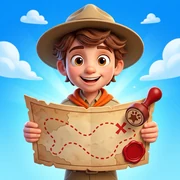
ExploraKidsMystery Trails
Urban scavenger hunt for children is a walk with stops where each clue encourages observation, problem-solving, or conversation before continuing. For it to work, the adult plans a safe and flexible route; ExploraKids adds narrated cases, challenges, and stamps in eight cities.
Define a simple mission before walking
A good mission can be summed up in a sentence: find a detail, compare two places, or discover what clue a character left behind. If the instructions are too long, the child may focus on remembering directions and stop looking around. Tell the story of Pip before setting off and ask what a detective would do upon arriving at a square. ExploraKids' description offers one case per city and a challenge at each stop. Double-check the actual starting point and don't promise that just any street will do as an official location.
Prepare an analogue alternative: a sketchbook, a short list of shapes, or three questions to discuss. That way, if the battery runs out or there's no connection, the outing still makes sense. It hasn't been confirmed whether the app downloads routes for offline use. The adult can narrate a clue in their own words if the child needs more context. When a puzzle is solved, ask why that answer fits with what you just saw.
Combine searching, listening and deduction
At one stop, a child might look for a shape of a certain colour; at another, listen to a story and find a difference. An older child might note down two suspects and decide which piece of information supports each hypothesis. This variety prevents all the evidence from being reduced to simply tapping an answer on the screen. ExploraKids describes a search and reward mode for younger children, and a notebook with suspects for older children. These mechanics allow for dividing tasks if adults are also playing.
Explain that a clue can be ambiguous and that it's okay to change your mind. Ask what information is missing instead of immediately giving the answer. Sometimes the appropriate challenge is to point to a building from a bench and chat; other times, walk to the next stop. Avoid photographing people without permission or entering restricted areas to "earn" a stamp. The mystery should be adapted to the real city and the rules of each place.
Plan short stops and long breaks if needed
A walk with children doesn't have to follow the same pace as an adult sightseeing alone. Alternate stops for sightseeing, water, shade, or a lunch break. Check the actual distance on an up-to-date map and add time for traffic lights, queues, and spontaneous sights. If the route crosses busy areas, establish a simple rule beforehand: check your phone while stopped, and the adult directs the crossing. The CDC warns of traffic risks for family trips, especially where traffic changes direction.
Don't publish a universal duration for all eight cities if the product doesn't support it. The same route can take longer with a stroller, rain, or a child fascinated by every detail. Flexibility is a practical feature, not a concession. If you arrive at a stop tired, you can listen to the history and leave the riddle for later. The digital passport and the stars are there to encourage you, not to dictate your pace.
A shared adventure, not a screen race
The description provided for ExploraKids proposes a walking route with stops at familiar places, a quiz at each stop, and a passport stamp upon completion of the city. The screen may pose a question, but the focus of the activity lies outside: an architectural detail, a square, a story, or a family conversation. Before opening the game, ask the children what they think they will find. At the end of each stop, invite them to look at the place again without their phones. In this way, the digital reward marks a real observation rather than replacing it.
UNICEF describes children's play as exploration and testing of ideas. This supports the general value of creating opportunities for play and conversation, but it doesn't prove that any one specific app will produce better historical knowledge. A detective story can provide a reason to look closely and formulate hypotheses. An adult can expand on a clue: "What part did you see?", "What other explanation could there be?". If one answer fails, go back to the location, listen, and try another possibility. It's not necessary to collect all the stamps for the outing to have been worthwhile.
Two ages, one family
According to the app description, the mode for younger children reads the clues aloud, prompts users to find and tap on objects, and always awards a prize. The older mode adds suspects, more challenging tasks, and a notebook to help deduce who did it and why. This difference allows siblings of different ages to participate in the same case without receiving exactly the same task. Check on your device which options are available in your language and how to change the mode.
Don't assign the level solely based on age. A fluent reader might enjoy a narrated clue, while an older child might prefer to look at pictures without pressure. Alternate roles: one listens, another searches, another explains, and an adult manages the route. If a puzzle requires reading, translate or rephrase as needed. The family goal is for everyone to contribute. A stamp or star doesn't indicate a fixed ability; it only records progress within the adventure.
Make the mistake another clue
If an answer doesn't match, look at the place again or listen to the instruction. Ask, "What did we see that made us think that?" You can offer a young child two visual options; an older child, ask them to rule out a hypothesis based on concrete evidence. Prevent a mistake from becoming a public display of frustration in front of siblings. In the ExploraKids description, younger children always receive a reward, while older children face more complex challenges; the adult can maintain a playful tone in both modes.
At the end, each participant can share a favorite clue, even if they didn't solve the mystery. You can write it in a travel journal along with a question to research later. This connects the journey to personal memories. UNICEF explains the role of exploration in the game; it doesn't automatically turn every scavenger hunt into a proven teaching method. Observation and conversation between people remain central to the experience.
Scavenger hunt without and with app
At home, you can create a three-clue scavenger hunt: a shape, a sound, and a short story about a street. You don't need technology to play detective. A ready-made app provides a story, challenges, and a route that can save planning when available in your chosen city. ExploraKids is announcing eight cases with Pip and stamps per city. Compare the actual route with your family's needs before deciding.
The digital option can be especially useful when siblings request different levels of difficulty. Even so, choose wisely when to put your phone away. A child can draw a building facade without uploading it to any platform. If the game requests data or permissions, consult its privacy policy on the actual product page; the provided description does not confirm those conditions. For teachers or large groups, review field trip rules, permissions, and supervision ratios before using any app.
Safety, rest areas and accessibility on an urban route
Before heading out, check schedules, roadworks, weather, water fountains, restrooms, and distances between stops using up-to-date local sources. A route described in an app may change due to closures or restrictions. Bring water and adjust the duration to the family's energy level. When crossing streets, adults should stop looking at their phones and accompany children; the CDC reminds us that traffic rules and directions can vary from country to country. Guidance from a game should never replace signs, official maps, or supervision.
If you're using a stroller or someone has reduced mobility, check curbs, stairs, and alternative transportation options before committing to the route. A stop can be enjoyed from an accessible location even if a digital quiz isn't completed. Take breaks and allow the family to stop solving the case without missing out on the family outing.
Frequently Asked Questions
What is an urban treasure hunt?
A route with clues or challenges that invite you to explore real places.
Should there be a material prize?
No; a stamp or a resolved story may suffice.
Is it suitable for siblings of different ages?
The app advertises two modes; distribute tasks according to skills and interests.
Does the route replace a map?
No; check streets, access points, and closures with current sources.
Can it be done offline?
This feature has not been verified on ExploraKids; please check it before your trip.
Sources and scope
For children's play and exploration, see UNICEF; for heritage education, see UNESCO; for travel safety with children, see the CDC.