Learning to add: games and steps for children starting with counting
Transparency: Numerana is made by AppRadar, the publisher of this website.

CroakulatorAdd & Subtract
On Google Play this app is listed as “Croakulator: Add & Subtract”; this guide calls it Numerana, the name used in the store description.
Learning to add involves understanding that two quantities can be combined and that one quantity can increase by adding another. It's helpful to start with objects and drawings before requiring answers using only numbers; the number line helps visualize each step.
First count small amounts
Before asking for 3 + 2, see if the child can count three objects without skipping any and say that the last number represents the total quantity. Place three stones or bottle caps and ask, "How many are there?" Change their arrangement without adding or removing any and repeat the question: the quantity is still three. There's no need to make it a long test. Playing games like sharing snacks or placing spoons offers natural opportunities for recognizing quantities.
Numerana begins, according to its description, by counting to five and ten, working with zero, and recognizing small quantities at a glance. This order prevents the plus sign from appearing before the quantity makes sense. If a child counts on their fingers, don't treat it as a mistake. Fingers are readily available objects that help relate numbers and quantities. Once a child recognizes small groups, they can put two together without always having to start counting again from one.
Adding as putting together and adding on
Combining and adding are similar but not identical situations. In "there are two ladybugs and three arrive," the quantity changes over time. In "there are two red ones and three yellow ones," the groups are already present and are being combined. Represent both cases with pieces and ask which was the initial group and which was added. Then draw two circles and three circles; finally, write 2 + 3 = 5. Repeat with other objects to prevent a single illustration from becoming a rote rule.
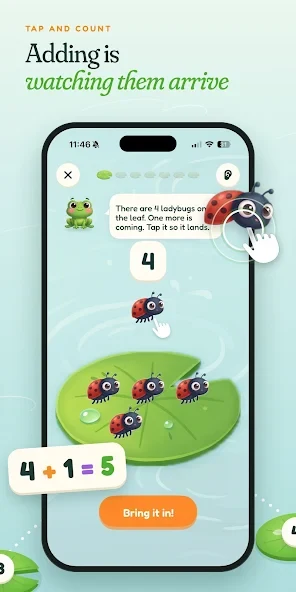
Numerana's description tells of ladybugs flying in to add. It invites the child to anticipate whether there will be more or less before counting. If they answer five, ask them how they knew: perhaps they counted them all, perhaps they started at three and added two. Both are observable strategies. Don't ask them to memorize a complete list of results in the first session. An answer they can explain with objects is a more solid foundation for later practice.
The lily-pad number line and its jumps
Place your finger on two and move forward three spaces: three, four, and five. A common mistake is to count the initial lily pad as the first move. Show it slowly: the starting number is two, and each move forward corresponds to one additional unit. You can draw a row of squares on paper or walk on marks on the floor. The What Works Clearinghouse recommends connecting a specific number path to the number line represented on paper.
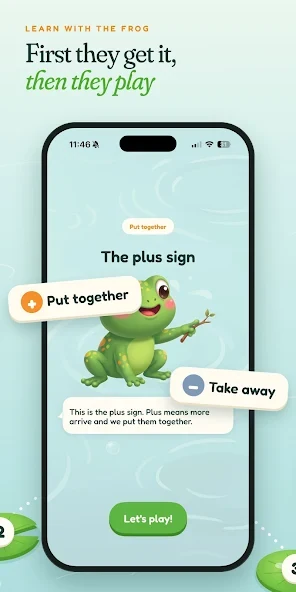
Numerana uses a row of lily pads as a number line. The picture can help explain direction, but explicitly discuss how addition moves forward and three jumps mean adding three. Later, ask what would happen if you started at the larger number in 2 + 5. Jumping twice from five is shorter than jumping five times from two; both end at seven. Let the child compare and discover the strategy before presenting it as a compulsory trick.

From objects to drawings and symbols
A sum written as 4 + 3 = 7 condenses many ideas: four objects, three being added, a final quantity, and a symbol that expresses equality. As a first approach, the child can move objects, count them, and then draw what they have done. Later, they recognize the written operation without always needing the physical objects. The Education Endowment Foundation recommends making the relationship between manipulatives, representations, and symbols explicit. Using a ladybug or a water lily does not, in itself, guarantee understanding; it is important to ask what it represents and why the quantity changed.
At home, accompany the process with a brief question: "What did you do first, and what changed?" If the child responds with their fingers, a drawing, or their own words, listen to their strategy before correcting them. Don't remove visual support to meet a deadline; use it when it helps and gradually simplify it as the child learns to explain the concept.
How to interpret errors and clues
An incorrect answer reveals whether the child has counted an extra jump, confused the sign, or misunderstood the problem. Avoid correcting only the final number. Ask them to show their method using objects, fingers, or a number line. The What Works Clearinghouse guidelines recommend systematic instruction, clear mathematical language, and well-chosen representations, especially when difficulties arise. This requires observing the reasoning, not just the score display.
Number bonds to ten and doubles
Pairs that add up to ten, such as 6 + 4 or 7 + 3, help organize later calculations. Use ten objects of two colors to show that the total doesn't change when they are redistributed. Doubles, such as 4 + 4, can be seen in two equal rows. Then explore almost-doubles: 4 + 5 is one more than 4 + 4. These relationships make sense if the child can check them; a memorized song with no connection to quantities may help with recall, but not with explanation.
The described course in Numerana includes number pairs, number bonds to ten, and doubles. The lotus garden prompts a review of memorized addition problems. Repetition can aid recall of specific facts, but it should be alternated with new problems and explanations. Ask "What other calculation is similar?" to avoid treating each sum as an isolated piece of information. If the child draws again, accept this approach while building confidence.
From ten to twenty and then to one hundred
For 8 + 5: 5 = 2 + 3; 8 + 2 = 10; 10 + 3 = 13. Draw the steps or use objects; don't jump to a verbal rule if the decomposition is still confusing. In larger numbers, tens and units appear. Two groups of ten and three units represent 23; adding another ten changes the number to 33.
The announced learning path ends with operations up to one hundred, carrying, column addition, and word problems narrated by Rana. Not all children will reach these topics at the same pace. Check that addition up to ten is understood before emphasizing carrying. A correct column calculation can mask a confusion about place value if a procedure is followed without understanding. Ask them to explain what group of ten has been formed and why the tens digit changes.
A short exercise that can go off-screen
A digital activity only makes sense when the child recognizes the same concept on the table. Place five pieces, add two, and count how many there are now. Remove three and ask what has changed. If they still need to point to them one by one, they are building a strategy; don't demand instant mental calculation. On a walk, you can count steps, two-colored cars, or flowerpots. The educational recommendation is not to turn every moment into a test, but to provide opportunities to use numbers meaningfully.
Frequently Asked Questions
When to use the + sign?
After exploring situations involving combining or adding quantities that the child understands.
Is counting on your fingers bad?
No; it can be a useful representation before finding other strategies.
What is a friend of ten?
A pair of numbers whose sum is ten, such as 6 and 4.
Does the app replace the teacher?
No; it can complement the explanation, the conversation, and other activities.
Sources and scope
For teaching early mathematics: What Works Clearinghouse on Early Childhood and Primary Intervention; for concrete representations and drawings: Education Endowment Foundation.