Tens and ones for children: from the group of ten to counting up to 100
Transparency: Numerana is made by AppRadar, the publisher of this website.

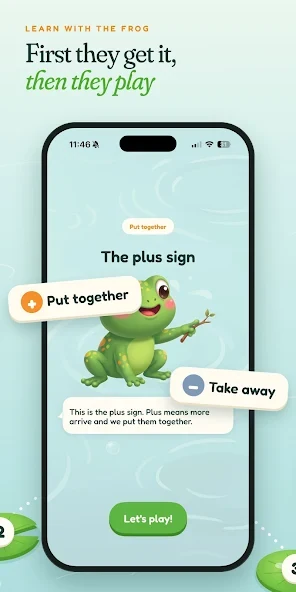
CroakulatorAdd & Subtract
On Google Play this app is listed as “Croakulator: Add & Subtract”; this guide calls it Numerana, the name used in the store description.
Tens and units for children are understood by grouping ten objects and recognizing that one ten equals ten units. Then, this group is connected to numbers like 24, which represents two tens and four units.
Make a group of ten visible
Count ten sticks with the child and tie them together with a rubber band: now there is a bundle representing ten units. Prepare another bundle and leave three sticks loose. Ask how many objects there are in total and why it can be said "two tens and three units." If they answer twenty-three, it is not enough to congratulate them: ask them to point out what the two and three represent. Change the order of the objects without changing the groups and check that it is still the same quantity.
Why 24 is not two and four objects
The digit two in 24 does not mean two individual units: it represents two groups of ten. The four does represent ungrouped units. Make 24 with two bundles and four pieces, then 42 with four bundles and two pieces. Compare which is greater and why. This contrast helps to identify a common confusion before performing calculations. Do not turn the explanation into a recitation of "tens to the left" without verifying quantities.
Write both numbers next to the objects. Then exchange ten loose units for a bundle and show that the total doesn't change. This exchange is important for understanding carrying. A child might count all the sticks from one at first; gradually, they can learn to count by tens and continue with the loose ones. Value the explanation, not the speed at which they say the number.
Using the hundred chart with helpful questions
On a chart from 1 to 100, look for 23 and 24: they are one unit apart. Look for 23 and 33: they are ten units apart. The exact orientation depends on the chart's design, so explain it before asking for moves. Play a game of discovering what changes in the digits when you add ten and what changes when you add one. Use numbers close to a ten-unit change, such as 29 and 30, to show that it's not enough to always keep the same units digit.
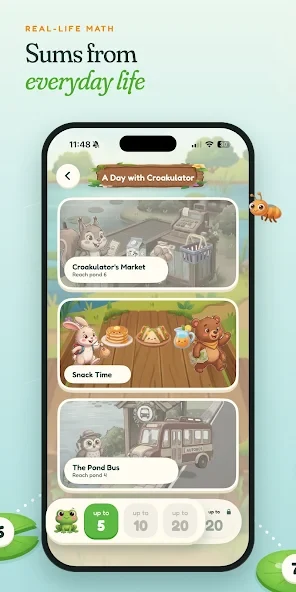
Numerana includes a 100 chart in the advertised course. When using it, connect each jump to the bundles and individual pieces. If the child sees 47 + 10 = 57 on the chart, they can check it by adding one bundle to four bundles and seven units. If the result is memorized as "going down one row" without any connection to quantities, it becomes fragile when changing resources. Alternating between the chart, objects, and writing reinforces the connection.
From objects to drawings and symbols
A sum written as 4 + 3 = 7 condenses many ideas: four objects, three being added, a final quantity, and a symbol that expresses equality. As a first approach, the child can move objects, count them, and then draw what they have done. Later, they recognize the written operation without always needing the physical objects. The Education Endowment Foundation recommends making the relationship between manipulatives, representations, and symbols explicit. Using a ladybug or a water lily does not, in itself, guarantee understanding; it is important to ask what it represents and why the quantity changed.
At home, accompany the process with a brief question: "What did you do first, and what changed?" If the child responds with their fingers, a drawing, or their own words, listen to their strategy before correcting them. Don't remove visual support to meet a deadline; use it when it helps and gradually simplify it as the child learns to explain the concept.
How to interpret errors and clues
An incorrect answer reveals whether the child has counted an extra jump, confused the sign, or misunderstood the problem. Avoid correcting only the final number. Ask them to show their method using objects, fingers, or a number line. The What Works Clearinghouse guidelines recommend systematic instruction, clear mathematical language, and well-chosen representations, especially when difficulties arise. This requires observing the reasoning, not just the score display.
Adding when a group of ten is completed
For 28 + 5, add two units to reach thirty, leaving three: the result is 33. With pieces, start with two bundles and eight loose pieces; add five, gather ten loose pieces into a bundle, and leave three. Then write the sequence 28 + 2 + 3. If the child struggles to separate five, first practice pairs that reach ten with smaller quantities. The strategy must arise from something they can see and explain.
A written column calculation can show the same exchange in another way. When adding eight and five units, thirteen is written as one ten and three units. Place the new bundle next to the other tens and count three bundles. Don't just teach where to write the little one. Ask what it represents and why it moves to the next column. The Numerana journey includes carrying; its usefulness depends on this conceptual bridge being clear.
Subtracting by exchanging one ten for ten ones
For 32 − 5, you have three packs of ten and two units. You cannot remove five loose pieces of only two; open one pack, so that you have two packs and twelve units. Remove five, leaving two packs and seven pieces: 27. The initial total did not change when the pack was opened. Repeat the process with drawings and finally represent the written account. If only one digit is seen to mysteriously change, the column subtraction will appear to be an arbitrary trick.
This example can be done with paper reeds, blocks, or ten-value play coins. Use objects large enough to avoid risks for young children. Once the operation is understood, try estimating: 32 − 5 must be slightly less than 32 and more than 22. Estimation does not replace calculation, but it helps to detect an absurd result. If the child gets stuck, go back to exact tens like 30 − 10 before adding units.
A short exercise that can go off-screen
A digital activity only makes sense when the child recognizes the same concept on the table. Place five pieces, add two, and count how many there are now. Remove three and ask what has changed. If they still need to point to them one by one, they are building a strategy; don't demand instant mental calculation. On a walk, you can count steps, two-colored cars, or flowerpots. The educational recommendation is not to turn every moment into a test, but to provide opportunities to use numbers meaningfully.
Frequently Asked Questions
What is a ten?
A group of ten units.
What does the 3 in 34 mean?
Three tens, that is, thirty grouped units.
Why is a ten exchanged for ten units?
To be able to operate with units without modifying the total.
Can the hundred chart teach on its own?
It helps when related to quantities and movements explained.
When to use columns?
After understanding groupings, exchanges, and the value of each digit.
Sources and scope
For teaching early mathematics: What Works Clearinghouse on Early Childhood and Primary Intervention; for concrete representations and drawings: Education Endowment Foundation.