Reading worksheets for kids: what to print and how to use them
Transparency: Letruga is made by AppRadar, the publisher of this website.
Reading worksheets for kids work best when they practise sounds and letters the child already knows, move from blending sounds to real words, and leave room to talk about what was read. Here is a practical structure for choosing and printing useful sheets without turning every page into a test.
Before you print: what can your child read?
An attractive worksheet can still be too hard if it uses a letter that hasn’t been taught yet. Ask which letters and sounds the school is working on, and check whether your child recognizes their sounds without help from a picture. Then give each worksheet one goal: hearing a first sound, blending sounds into words, reading words, building a sentence or understanding a story. When a single page mixes every goal, it is hard to tell what needs more practice.
Research summarized by the Education Endowment Foundation favours explicit, systematic phonics teaching matched to what the child already knows about sounds and letters. Paper can add extra practice, but a worksheet on its own doesn’t teach: someone has to explain a new letter–sound link and correct mistakes kindly. Talking together and shared reading still matter.
In Spain, for example, the early years curriculum describes a gradual approach to written language, built on curiosity, enjoyment and respect for each child’s pace, which is then consolidated in primary school. Wherever you live, don’t use a worksheet for a four- or five-year-old as proof that they ought to be reading already. Use it to explore meaningful words, and to note questions for the teacher when the same difficulty keeps coming up.
Worksheet 1: listen for the first sound
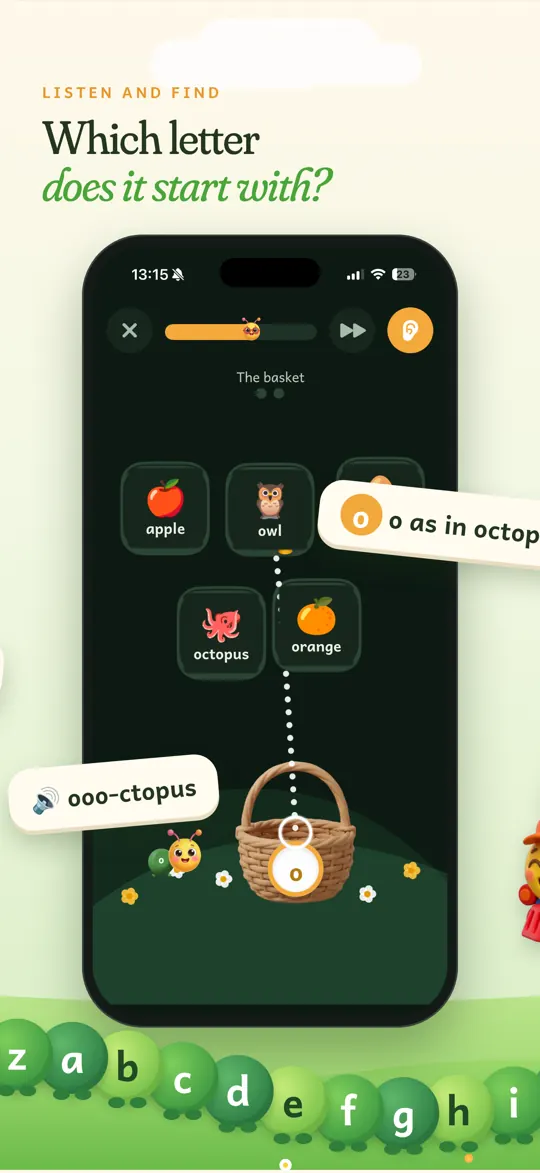
The first page can show three or four easy-to-recognize pictures and ask the child to name them, listen to the first sound and circle the ones that start the same way. Add the letter in large print and an arrow so the adult can model the sound. If the child gets it right only because all the correct pictures sit in one column, change the order before printing. Avoid words whose first sound changes with the accent, and objects your family calls by a different name.
For a sheet on the s sound, you could pick sun and sock, plus two clearly different contrasts such as dog and moon. The page shouldn’t rely on colouring in: ask your child to say the words aloud and explain why they circled some pictures and not others. If they want to draw something of their own that starts with the same sound, you get a chance for conversation and new vocabulary that doesn’t fit in an answer box.
A sheet like this has to be rebuilt for each language. Translating the instructions and keeping the pictures is not enough: sock starts with s in English, but in Spanish it is calcetín, which starts with a k sound. For every language version, check the name of each object, the recorded pronunciation and its link to the target letter. Translating a phonics activity is a small editorial and teaching job in its own right.
Worksheet 2: blending sounds into decodable words
On another sheet, show one blending model such as s-a-t → sat, followed by a few short words that use only letters the child has learned. Ask the adult to point to each letter, say each sound and then say the whole word. Don’t add a long list of new letter combinations, and don’t use pictures that let the child guess the answer without looking at the letters.
Once s, a, t, p, i and n have been taught, possible examples are pin and tap, as long as those letter–sound links really are part of the sequence your child is following. If your child reads the word, ask what it means and make up a simple sentence together. If they say the separate sounds without blending them, use fewer words and model the blend. In a later session, show another word made from the same letters to check whether they can transfer the skill.
A well-designed worksheet lists the letters it assumes in a corner, for the adult. That saves a family from downloading a sheet with a generic title and finding out too late that it includes digraphs such as sh, ch and th, or vowel teams like ai and igh. Legibility matters too: large letters, plenty of space between words, strong contrast and one main task per page.
Worksheet 3: tracing with a purpose
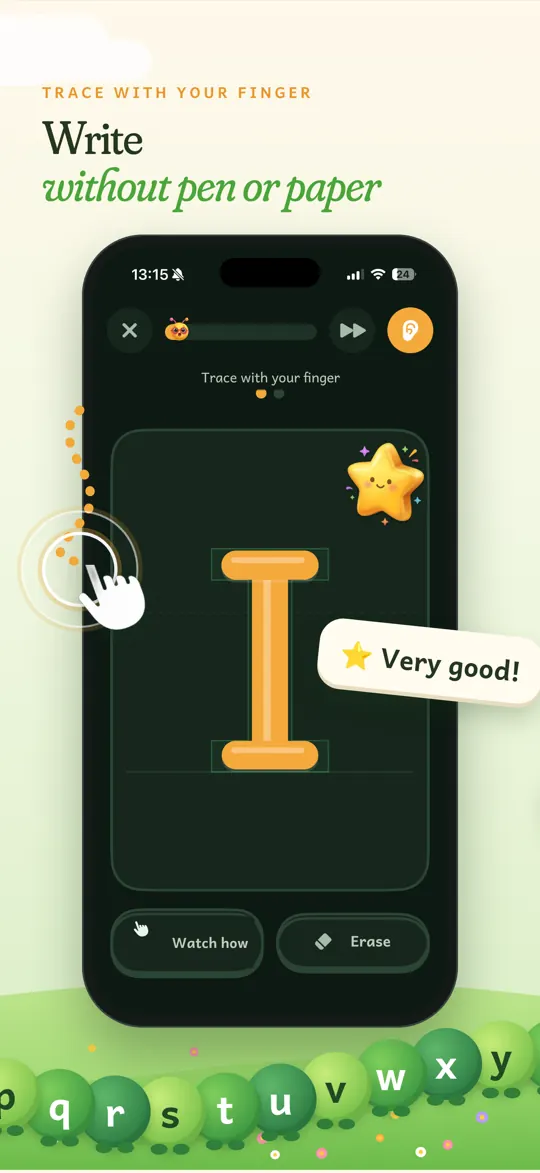
Letter formation can be practised with one large letter, its direction marked, and a small space to write a word that contains it. The EEF highlights the value of showing how a letter is formed, giving feedback and writing for a real purpose. There is no need to fill whole pages with the same letter. A label for a drawing or a note to someone gives the movement a meaning.
Before choosing a typeface, check which handwriting style the school uses. In its English course, Letruga offers three letter styles: print, capitals and cursive (joined) letters, which are drawn from a Spanish school model (Playwrite ES). You can keep the school’s style on paper to avoid confusion, without claiming that any typeface makes better readers on its own. If your child finds the movements hard, offer magnetic letters or larger shapes and ask for individual advice.
A tracing sheet doesn’t show that a child can decode the letter. Ask them to say its sound and find it in another word. The reverse is also true: reading a word well doesn’t require perfect handwriting. Reading and writing support each other, but they involve different skills that are best observed separately.
Worksheet 4: read a sentence and answer
Once your child can read simple words, offer two sentences built from known letters and a direct question: who did something, or what happened. Avoid exercises where the child only matches a sentence to a picture by its colour. Let them read first, then show the picture, and finally talk about what it means.
You can add a box for the child to draw the action. If the sentence says Sam sat in sand, the drawing should show that action without bringing in words they would have to read to answer. A spoken question such as “Where did Sam sit?” checks whether they understood. At home, a sheet like this takes a few minutes; you can spend the rest of the time telling a story together.
The EEF reminds us that decoding and comprehension go hand in hand. A page of correctly read words is not enough to say that a child understands. Ask about meaning, let them answer in their own words and model an answer if they need help. Short answers are not a memory test.
Four free printable PDF worksheets
Here is a free starter pack in English: four separate A4 PDFs. The first is about the first sound s; the second, blending short words with s, a, t, p, i, n, m and d; the third, tracing the first six letters of Letruga’s English course (s, a, t, p, i, n) in print and in cursive; the fourth, short sentences with a comprehension question. Each PDF has an activity page and a second page with answers and notes for the adult, including the letters the sheet assumes. Print only the sheets you need.
- First sound: sSix pictures: circle the ones that start with the s sound.A4 PDF · 2 pages: activity and answers · Download PDF
- Blending: s a t p i n m dTen short words to sound out and blend, and four words to match to their picture.A4 PDF · 2 pages: activity and answers · Download PDF
- Tracing: s a t p i nThe first letters of the course with a start dot and arrows, in print and in cursive.A4 PDF · 2 pages: activity and answers · Download PDF
- Read and answerFour short sentences, each with a spoken question and three pictures to choose from.A4 PDF · 2 pages: activity and answers · Download PDF
For a more advanced set, make separate sheets for digraphs such as sh, ch and th, for vowel teams like ai, ee and igh, and for consonant blends such as st and fr. Make the level clear in the file name and check every word before printing: a single word with an untaught letter or spelling turns reading into guessing.
Letruga includes printable worksheets and tracks progress by letters and sounds. An adult can use that progress to choose what to practise next and then check whether the skill carries over to paper. The app doesn’t have to be your only source of material: a note to a relative, a sign or a library book all give reading a real purpose.
How to use a worksheet without pressure
Read the instructions with your child, show an example and let them try two or three items. If they make a mistake, point to the relevant part and go back to the sound; don’t complete the sheet for them. Stop while there is still energy left for a story or a chat. Worksheets are not a race to fill a binder.
Keep a dated sample if it helps you see progress, but don’t use it to compare siblings. What matters is whether your child can recognize and use a new letter–sound link outside that page. When you need to, share a concrete example of a difficulty with the school. The Spanish pediatric association AEPap encourages reading aloud and playing with language: a worksheet is only one small part of that.
If an activity needs too many hints, go back a step. Switch to a letter your child knows, read the story to them yourself and come back to the sheet another day. Useful practice respects the child’s pace and keeps their interest in stories alive.
Frequently asked questions
Are there PDFs to download on this page?
Yes. This page has four free A4 PDFs: first sound, blending words, tracing, and sentences with a comprehension question. Each one has an answer page and lists the letters it assumes.
How many worksheets should a child do each day?
There is no set number. One short worksheet may be enough; put conversation, shared reading and the teacher’s guidance first.
Can I translate the same worksheets word for word?
Not usually. Sounds, pictures, words and letter order have to be adapted to the way each language is written.
Which letters should appear on a sentence worksheet?
Only letters the child already knows from the sequence they follow, apart from a word that the adult explains and reads.
Does a tracing worksheet teach reading?
It practises letter formation. Pair it with the letter’s sound, reading words and talking about meaning.
Sources
Revised on November 11, 2026. Spanish Ministry of Education, early years curriculum; EEF, phonics; EEF, letter formation; AEPap, shared reading; Letruga on the App Store. The practical recommendations are editorial. Features, prices and languages may change: check your store listing before paying.