Tablitas: a small revolution for practicing multiplication tables that's worth trying
Transparency: Tablitas is made by AppRadar, the publisher of this website.
There's a scene many families are familiar with: it's time to review the multiplication tables, and the conversation begins with a negotiation. How many exercises, how much time, why again? Tablitas invites you to approach this scene differently: start with a small action and a specific operation. Even if this is a new idea for you, it's worth exploring and seeing how it fits into your learning style.
We call this shift in perspective a "small revolution": moving from trying to master all the multiplication tables to preparing a meaningful practice session. This is an editorial assessment of the app, not a claim of proven superiority over other apps. The interesting thing is what you can see for yourself: whether it makes it easier to get started, whether it helps you identify areas for improvement, and whether it helps you discuss multiplication without turning it into a battle.
The revolution can begin with a smaller question
“You have to learn your multiplication tables” is a huge instruction for someone who is still unsure between two answers. “Let’s see what seven times eight is” presents a more concrete task. The difference isn’t just in the number of exercises, but in that the child can understand what is being asked of them and when they will have finished that part of the work.
That's the perspective from which we propose discovering Tablitas. You don't need to wait until all the operations are forgotten or set aside an entire afternoon. You can choose a multiplication problem, represent it, and set aside some time to practice. Then, the question stops being "Have you finished yet?" and becomes "How did you come up with that answer?"
Imagine a possible scenario, not a real-life example: a family chooses 7 × 8 because it appeared in their homework. Draw seven rows of eight dots, find fifty-six, and return to the operation in a different format. The session ends when the child can explain part of the reasoning. The progress observed is concrete and does not depend on announcing that they have mastered all the multiplication tables.
What Tablitas offers and what you can appreciate when you try it
The official presentation of Tablitas describes one-minute games for the multiplication tables from 1 to 10, practice focused on difficult operations, and family follow-up. See the Tablitas website. This combination offers a starting point for a practical question: can a small activity find a place in your routine?


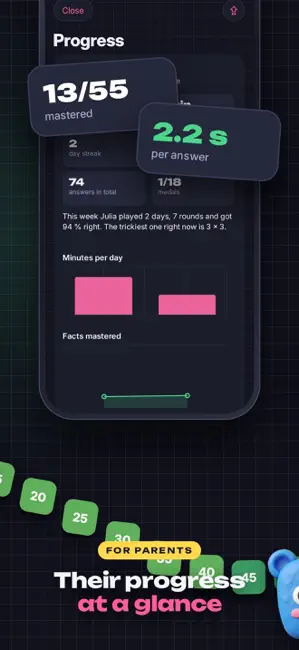
The advertised duration of a round should not be interpreted as the total time any child needs to learn. You can dedicate an extra moment to acting out an operation or discussing a question. The value of a brief entry lies in its ability to provide a concrete starting point; what happens afterward will depend on the situation and the support each family needs.
When exploring the app, observe whether the child understands what to do and how they respond when they encounter a difficult operation. A positive first impression may encourage continued use, but the decision to keep using it should also be based on these observations. Testing a tool carefully allows you to choose based on your own experience, without relying solely on a marketing description.
A proposal that connects different ways of practicing
The iOS listing describes 13 games, printable worksheets, and exams with certificates. It includes a free portion and full access with a one-time purchase, no subscription required. See features and terms in the App Store. Specific details should be reviewed in the version you intend to use.
For a family, variety makes sense when it helps to look at the same operation from different angles. A representation with dots can clarify the groups; a short question can recall the result; a paper activity can show what happens without the visual cues of the screen. It's not about completing all the available options, but about choosing the one that answers the question at that moment.
You can create your own connection between formats. If you work with 8 × 6 today, write a story afterward using eight sets of six pieces. If the child understands the story but doesn't remember the outcome, you know which part needs support. If they remember forty-eight but can't identify the groups, you can go back to the drawing. This distinction makes the next activity more intentional.
A mistake can become a useful conversation
When an answer is incorrect, there's a temptation to quickly correct it and move on to another question. However, the answer may contain a clue about how the child is thinking. Perhaps they're remembering a similar operation, undercounted a group, or interpreted the question differently. Knowing this explanation changes the help you can offer.
When trying out Tablitas, set aside a moment to discuss any questions that may have arisen. You don't need to stop every question or become an examiner. You can choose a single operation and ask, "What number came to mind?" or "How could we check it?" The app can be part of the activity; the conversation provides the context you observe.
This approach also changes how progress is recognized. Correcting a response with an explanation is valuable, even if the first attempt failed. You can highlight a specific action: "You checked how many groups there were." This is a more precise observation than a general label and offers the child a strategy they can reuse.
A privacy decision worth understanding
Tablitas's policy states that profiles and progress remain on the device, without accounts, ads, or tracking tools. It also explains that deleting the app deletes this data. These are statements from the product owner; it's advisable to read them before using the app. View the privacy policy.
For a family, this raises a practical conversation about where activity is saved. Don't assume there's a cloud backup or that progress will automatically appear on another phone. If you're switching devices, review the available options and keep what you need before deleting an installation.
The stated absence of ads is also an aspect you can consider when choosing a practice environment. The family decision should take into account the whole picture: clarity of the activities, access conditions, privacy, and ease of stopping when you're finished. No single label replaces examining how a tool fits into your context.
Why a new app deserves a chance
A newer app may have fewer reviews or less presence on well-known lists. That doesn't necessarily mean it's better or worse for your family. It simply means it deserves a proper evaluation: verify its identity, read its description, and run a short trial before deciding whether to incorporate it into your routine.
Instead of simply asking how many people use it, you can ask yourself what problem you want to solve. Perhaps you need a starting point for practice without preparing many cards. Maybe you're looking for a way to review a few operations. Or perhaps you want to observe how your child responds in a format other than a workbook. These needs offer concrete criteria for evaluating the experience.
Tablitas deserves this opportunity precisely as a proposal you can explore, not as a promise you must accept without checking. Discovering something new doesn't require abandoning what already works. You can continue with the school explanations and family games while you decide if this tool provides a useful moment of practice.
How to test Tablitas with a real objective
Before downloading, choose a multiplication problem or a small set of operations. Note how you solve it now: whether you remember the result, need to draw a diagram, or use addition. This isn't about assigning an initial grade, but rather having an observation you can refer back to later.
Check your store's listing, review compatibility, and distinguish between free access and paid content. During the first session, guide their exploration. Observe which instructions they understand and what questions they ask. If part of the interface is unclear, help them without interpreting this difficulty as a math problem.
When you finish, write down a related question. You can change the order of the factors or make up a simple story. Listen to the explanation and note anything you want to look at again. This check does not demonstrate the overall effectiveness of an app; it is to understand what happened in your specific test.
Repeat the experience another time if you found it suitable. This will help you distinguish between the novelty factor and an activity you genuinely want to continue. You don't need to buy additional content to formulate those initial observation questions; explore what you can with the access available in your store.
What to look for besides the correct answers
The first indicator is whether they understand the task. The second is whether they can revise an answer without automatically quitting. The third is whether they recognize an operation when the format changes. It's also important to know if they can finish the activity and move on to something else as planned.
These observations avoid making the number of minutes the sole measure of a session. A short activity with a clear explanation can provide useful information. A long session, on the other hand, may need revision if it becomes mechanical. The question is what purpose that time serves within your plan.
You can ask the child what they found easiest and what they would like to repeat. Their answer doesn't have to decide the choice on its own, but it provides an important perspective. They will use the tool; the family organizes the conditions and supports those who still need help.
For whom might this test make sense?
This invitation is for families who want to explore a way to practice multiplication tables and are willing to see how it fits with their child's learning. It may also be of interest to those looking to alternate digital activities with offline exercises. The child doesn't need to be starting from scratch to choose operations that are worth reviewing.
If you still don't understand what equal groups are, start with objects and drawings. If you know the results but get confused when mixing them up, prepare a small selection. If the difficulty arises with written problems, pay attention to the language of the problem statement. The same tool can play a different role in each case, and sometimes the next step will be an explanation outside of it.
For persistent difficulties, coordinate practice with the teacher and share concrete examples. An app does not replace assessing the student's needs, nor can it be promised that everyone will progress at the same pace. Its place in the routine should be decided based on what it contributes and what still requires other types of support.
Frequently Asked Questions
Why do we call Tablitas revolutionary?
We use that word as an editorial assessment of the possibility of changing the routine: starting with a specific task, noting any doubts, and discussing what has been learned. We are not claiming that it has proven educational superiority or that it is the only app with this approach.
Is it worth trying even though not many people know about it yet?
You can evaluate an app based on how well it addresses a specific need, in addition to its popularity. Read its description, check the terms and conditions, and run a small test. Newness doesn't guarantee quality, but it's not a sufficient reason to dismiss it either.
Is this article based on an independent practical test?
No. This is branded content created from publicly available product information and original suggestions for family use. We do not present user testimonials or results from tests conducted with children. We invite you to evaluate its suitability for your context.
Is one round enough to learn the multiplication tables?
It cannot be guaranteed. A round can be part of practice, but learning requires relating, remembering, and applying operations. Observe what the child needs and combine activities when it makes sense, without interpreting a short duration as a promise of complete mastery.
Where can I download Tablitas?
You can find Tablitas on Google Play and Tablitas on the App Store. Check availability, compatibility, and terms and conditions displayed by your store before downloading or purchasing.
What should I do after the first test?
Retrieve an operation from outside the application and ask how they would solve it. Note a specific observation and decide whether you want to repeat it, change the activity, or work on an explanation first. This decision is more valuable than simply keeping the tool for the sake of novelty.
Give it a try with a specific question
The best way to find out if Tablitas has a place in your routine is to prepare a meaningful test. Choose an operation, accompany the first session, and see what conversation arises afterward. Even if it's new to you, it might deserve that little bit of space in your review. Start with its worksheet and continue with our practice plan at home or compare approaches in the top 6 apps for learning multiplication tables.