Best apps to get over a breakup: six options to choose from
Transparency: Kintsugi is made by AppRadar, the publisher of this website.
Best apps for getting over a breakup: Our editorial selection places Kintsugi first for combining a no-contact counter, guided journaling, privacy (no account or ads), and a store listing available in over 40 languages. AppRadar, the publisher of this site, develops Kintsugi, so the ranking is an editorial opinion based on explicit criteria and not an independent measurement. No app is a substitute for a mental health professional.
How we ordered the ranking
We compared the apps based on six criteria: tools to avoid texting your ex (day counter, help when the urge strikes), a journal or space to organize your feelings, available languages, handling of personal data, price clarity, and signs that professional help is available. The data comes from each app's App Store listing, consulted on November 12, 2026; we did not measure their effectiveness in a laboratory setting nor did we test all paid features.
We also haven't found any clinical trials evaluating these apps in those listings. It's a new category, and most are support and organizational tools, not treatments. Therefore, each app's ranking reflects what it offers and how it presents it, not how much it helps a specific person. Features, prices, and languages change: always check the current listing in your store.
1. Kintsugi: no contact, diary and privacy
Kintsugi for iPhone and Kintsugi for Android are the two official store listings. Their descriptions present a daily guide to overcoming a breakup, using the Japanese metaphor of repairing pottery with gold: each day, five small acts of self-care are completed (another day without contact, a check-in or a journal entry, the day's step in a guided program, a routine, and a moment of calm), and every three acts add a fragment of the pottery. It includes a no-contact counter with milestones of 1, 7, 30, and 90 days, a help button for when you feel the urge to text (The Anchor), a guide for when your ex texts you, a 32-module program, a journal with 55 questions, and 32 routines.

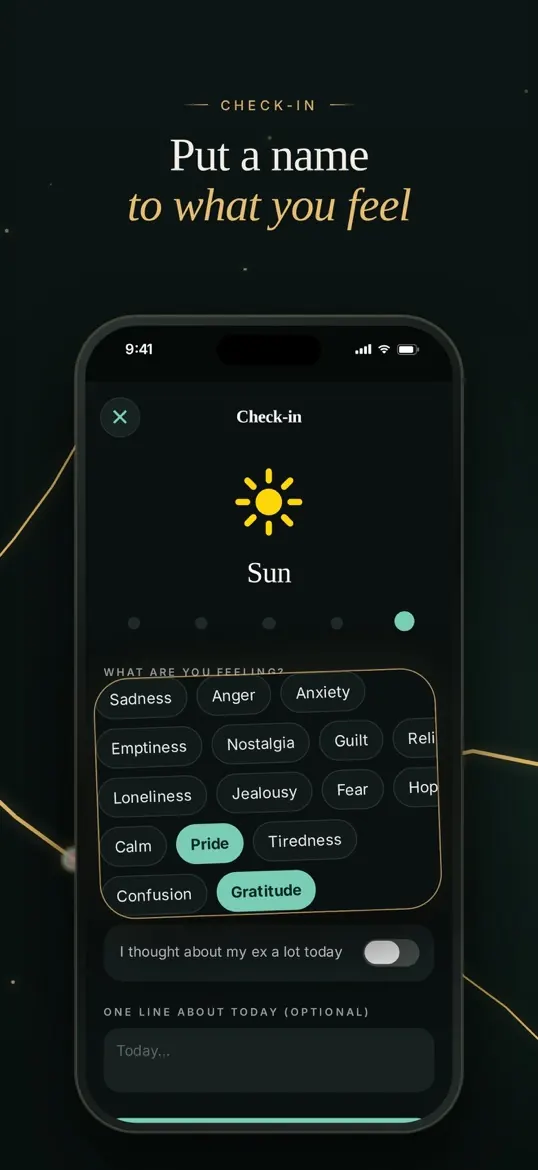
The description indicates that it works without an account, without ads, and without tracking, with data stored encrypted on the phone and locked with Face ID or fingerprint; the privacy policy explains that there are no proprietary servers or analytics. The Counter, Vessel, Check-in, Free Journal, Basic Anchor, and Emergency Help are free; Kintsugi Pro unlocks the full year, Repair Index, Difficult Dates, and the rest of the tools. Check the price on the purchase screen for your country.
It also has limitations. It's a new app (version 1.1) with very few public reviews yet, it doesn't include AI chat or a community feature, and its description mentions 50 languages even though the App Store's technical list shows 44. It's designed for self-care: the description itself states that it doesn't replace professional help.
2. No Contact: AI-powered coaching and community
No Contact: Breakup Recovery (Ember Labs) is one of the most comprehensive apps in its category. Its description mentions a streak counter, a one-tap "Panic Room" for impulsive moments, a space to write the risky message first, an "Evidence Vault" to save screenshots that remind you why it ended, an AI coach named Kai, a community, guided programs, and a library of articles. It includes a free trial and an auto-renewing subscription.
It's a good option if you want to chat with an assistant and share the process with others. Before deciding, keep in mind that its App Store listing is only in English, it's rated 17+, and it presents itself as an "AI therapist": an automated assistant is not a healthcare professional. Review what data you share in the chats.
3. Get Over Him: Message Simulator and AI Companion
Get Over Him (Dial Labs) is designed for those recovering from a breakup with a man (its description always refers to "him"). It offers a real-time no-contact countdown, an AI companion named Mochi (via text or voice), a message simulator that shows how the conversation would go without sending anything, a personal promise, chapter-based lessons (self-love, boundaries, closure, trust), quizzes such as the attachment style quiz, a journal, and a widget. The listing is only available in English.
Attachment questionnaires and "readiness to date again" questionnaires are tools for reflection, not diagnoses. The texting simulator is an original idea for curbing impulses, although there are no studies measuring whether it works better than other techniques.
4. Zero Contact: Streak, Breathing, and Fake Message
Zero Contact: Heal Faster (Reframes Group) combines a streak counter with badges, a "fake text to your ex" that never gets sent, guided breathing (box and 4-7-8), quick tips, and a mood journal. It works on a weekly or annual subscription basis, with a possible free trial for new users. It's currently only listed in English on the App Store and is rated 17+.
If you're interested, check the actual price of the weekly subscription and how to cancel it in your Apple account settings before starting the trial.
5. Breakup Buddy: AI chat and CBT exercises
Breakup Buddy (Applorium) focuses on a 24/7 AI chat service with conversation credits (the listing mentions 2,500 free credits for new users), community-shared links, exercises "based on cognitive behavioral therapy," and a journal with prompts and analytics. Its description warns that it is not a substitute for professional advice and advises calling emergency services if you think someone might harm themselves. English is the only language available.
“Based on CBT” describes the inspiration behind the exercises, not that they are equivalent to therapy with a psychologist. If the chat is helpful, use it as a support tool and not as your only source of help.
6. Daylio: a mood diary, not a breakup app
Daylio (Relaxio) isn't designed for breakups, but it's a useful tool if you just want to jot down how you're feeling without writing at length: you choose a mood, mark activities, and view statistics and a calendar. Its description lists 46 languages, indicates that data is saved to the phone with optional backup, and allows PIN locking. It doesn't include a no-contact counter or specific content about breakups.
Which app to choose based on your needs
If your biggest challenge is not texting your ex and you'd prefer an app in your language, without an account and without AI chat, start with Kintsugi. If you want to talk to an assistant and a community and you read English, check out No Contact or Get Over Him. If you like the idea of composing a message without sending it, both Get Over Him and Zero Contact include that feature. If you just want to log your mood, Daylio is sufficient.
You don't need to decide right away. You can try two apps for a week and stick with the one that's easiest to open in a pinch. In this no-contact guide we explain what that counter is for and when it's not enough.
How to test an app without it becoming another obsession
Choose a simple goal, for example, opening the app once a day and using it when you feel like writing. Turn off notifications that make you anxious and don't compare your streak to other people's. An app shouldn't be used to stalk your ex: a study of 464 people found that monitoring their Facebook was associated with more distress, more longing, and less personal growth (Marshall, 2012), although, being correlational, it doesn't prove that it causes it.
When an app is not enough
According to the UK's NHS, you should consult a doctor if you've been feeling low for more than two weeks, if you're finding it difficult to cope, or if what you're doing on your own isn't helping. A no-contact app is not a substitute for a psychologist or psychiatrist. If you're thinking about harming yourself, call 024 (Spain's free 24-hour suicide helpline) or 112 immediately; in other countries, find the local service at findahelpline.com.
Frequently Asked Questions
What's the best app to get over a breakup?
It depends on what you're looking for. In this ranking, Kintsugi comes in first for its zero-contact counter, journal, privacy features, and language support; No Contact stands out for its AI coach and community, and Daylio for the simplicity of its journal. This is an editorial selection by AppRadar, the developer of Kintsugi.
Do no-contact apps work?
There are no studies that evaluate these specific apps. There is research on contact with an ex: in a follow-up study of 58 young people, maintaining contact delayed the decline of feelings of love and sadness (Sbarra and Emery, 2005). These are small, observational studies, so an app can only be an aid in helping you make your decision.
Are there any apps in Spanish to help you get over a breakup?
Kintsugi is available in Spanish on iPhone and Android. In the App Store listings consulted, the other breakup apps in this ranking are only listed in English; Daylio is translated into 46 languages, although it is not specifically about breakups.
Are they free?
All are free to download, but most offer paid features or subscriptions. In Kintsugi, the Counter, Vessel, Check-in, Free Journal, Basic Anchor, and Emergency Help are free; Kintsugi Pro unlocks the rest. Always check the price in your country before paying.
Can they replace a psychologist?
No. These are self-care tools to help you organize your daily life. If the discomfort lasts more than two weeks, prevents you from working, sleeping, or eating, or if you have thoughts of harming yourself, seek professional help.
Sources and revision date
Content reviewed on November 12, 2026. Sources: App Store listings from Kintsugi, No Contact, Get Over Him, Zero Contact, Breakup Buddy and Daylio; Marshall (2012), Cyberpsychology, Behavior, and Social Networking; Sbarra and Emery (2005), Personal Relationships; NHS, Low Mood and Depression. This information is general and does not replace the assessment of a healthcare professional.