How to get over a breakup: a guide for the first 30 days
Transparency: Kintsugi is made by AppRadar, the publisher of this website.
To get over a breakup, during the first month focus on four things: reducing contact and opportunities to see your ex, taking care of your sleep, food, and exercise, putting your feelings into words, and seeking professional help if the distress doesn't improve or prevents you from functioning. There's no universal timeline or technique that guarantees speed: sadness tends to come and go, and some days hurting more than others doesn't mean you're making progress.
First: it's normal for it to hurt so much
A breakup can hurt physically. In an MRI study of 40 people who had experienced an unwanted breakup in the previous six months, looking at a photo of their ex activated brain regions that also respond to physical pain (Kross et al., 2011). Subsequent analyses discuss how similar the two types of pain are, so it's best not to exaggerate the comparison, but rather to focus on what's helpful: your reaction is neither a weakness nor an exaggeration.
Week 1: Getting through the first few days
At first, the goal isn't to "get over it," but to make it to the end of each day. Try to sleep at regular times, eat something even if you're not hungry, drink water, and go outside for a while. Avoid making big decisions (moving, changing jobs, announcing the breakup on social media) while you're going through the worst of it.
Tell at least one trusted person that you're feeling down. The UK's NHS recommends against using alcohol, tobacco, gambling, or drugs to relieve low mood, as these can make it worse. They note that low mood often improves within a few days or weeks with small changes, such as addressing your worries or getting more sleep.
Reduce contact and opportunities to look
Every message, story, or photo from your ex reopens the wound. A study of 464 people found that monitoring an ex's Facebook was associated with more distress, more longing, and less personal growth (Marshall, 2012); since it's a correlational study, it doesn't prove that it causes these feelings, but it aligns with what many people notice. Mute or archive their profiles, move the conversation out of sight, and ask mutual friends not to tell you anything.
If you decide on a period of no writing or responding, we call it no contact: we explain it in this no contact guide, with its limits and exceptions (children, work, safety).
Weeks 2 and 3: Getting back into a routine
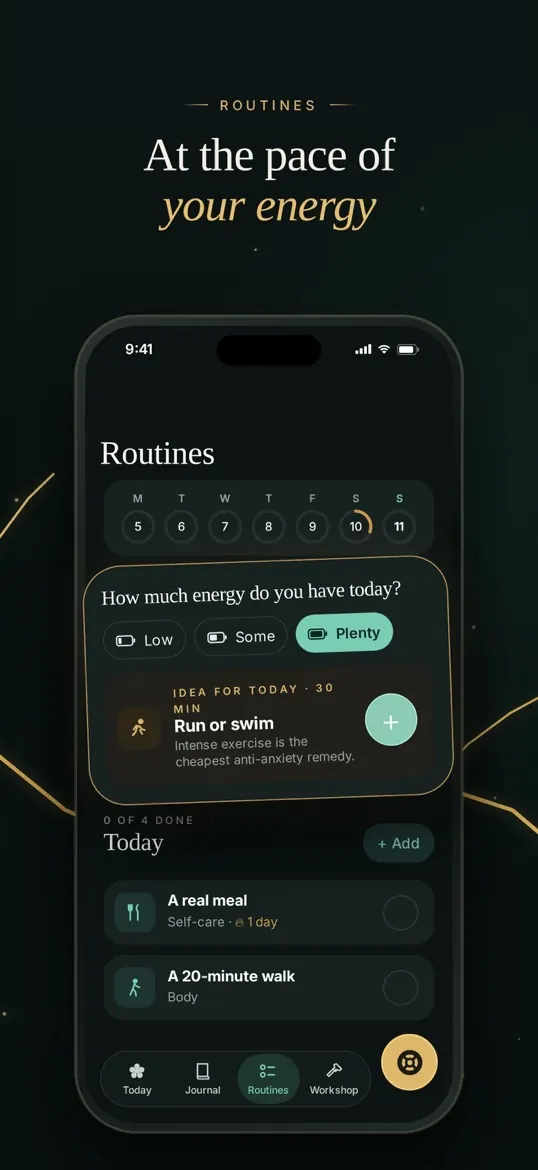
When the worst of it is over, a small routine is more effective than a grand promise: a fixed time to get up, a real meal, ten minutes of exercise, and plans with someone every few days. Reclaiming what the relationship displaced (friendships, hobbies, sports) works as a way to rebuild, not as a distraction.
Put away in a box, out of sight, the objects that upset you. You don't have to throw them away or make any permanent decisions; just make sure they don't haunt you every day.
Put what you feel into words
Writing about a breakup can help clear your head. A randomized trial with about 145 students compared expressive writing about a breakup with writing about neutral topics and measured mood, cognitive processing, social adjustment, and health (Lepore & Greenberg, 2002). It's a study with university students, and not everyone benefits equally; as a practice, it's simple and free, but if writing becomes too emotional, stop and talk to someone.
Some questions to get started: What do I truly miss, the person or the company? What hurt me that I didn't say? What do I need this week? What would someone who truly cares about me do for me today? You don't need to write beautifully or reread what you've written.
Treat yourself with kindness
Talking to yourself as you would to a friend is not a luxury. In a study of 109 adults going through a divorce, those who showed more self-compassion when talking about their separation were less distressed at the beginning and nine months later (Sbarra, Smith, & Mehl, 2012). It is an observational study, but it suggests that treating yourself with kindness is part of recovery and does not delay it.
Week 4: Take stock without putting too much pressure on yourself
At the end of the first month, look at what has changed, even if it's small: Are you sleeping better? Are you spending more time without thinking about your ex? Have you had any good days? Also, make a note of any difficult dates coming up (birthdays, anniversaries, planned vacations) and prepare a plan for them.
If you had a relapse (you texted them, looked at their photos again), don't start over with guilt: get back to your routine and start counting from today.
What to avoid
Writing in the early hours of the morning, analyzing every old message looking for the mistake, finding a quick replacement to avoid feeling, using alcohol to sleep, comparing yourself to your ex's new life you see on social media, or isolating yourself for weeks. None of these things prove you're doing something wrong; they're just common traps.
When to seek professional help
According to the NHS, you should consult a doctor if you have been feeling low for more than two weeks, if you are finding it difficult to cope, or if what you are doing on your own is not helping. Seek help sooner if you are unable to work, sleep, or eat, if you feel trapped, or if there is violence or harassment in the relationship. If you are thinking of harming yourself, call 024 (the suicide helpline in Spain, free and available 24 hours a day) or 112 immediately; in other countries, find the local service at findahelpline.com. If there is violence or fear in the relationship, in Spain you can call 016 (information and advice on violence against women) or 112 if there is immediate danger.
How an app can help you
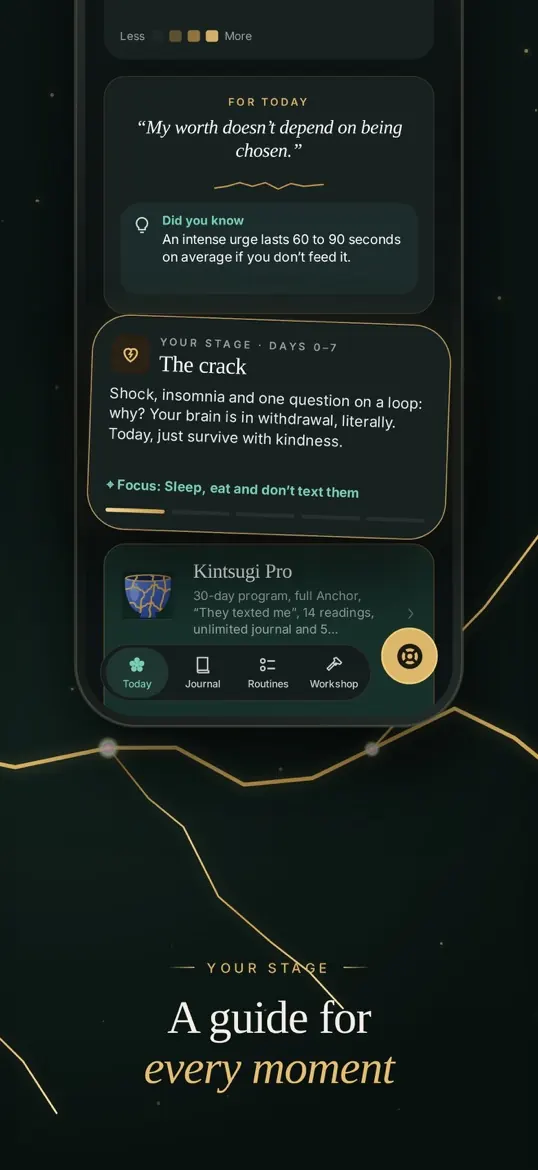
An app won't cure a breakup, but it can make it easier to maintain the habits of the first month. Kintsugi for iPhone and Kintsugi for Android (AppRadar, the publisher of this site, develops Kintsugi) offer five small daily gestures, a no-contact counter, a guided journal, and a program that opens a new day each morning for the first month. It works without an account and saves the data to your phone. If you want to compare it with others, see the best apps for getting over a breakup.
Frequently Asked Questions
How long does it take to get over a breakup?
There's no single timeframe. Most people recover over time, but the pace varies greatly depending on the person, the relationship, and subsequent contact. We explain this with data in How long does it take to get over a breakup.
Is it better to cut off all contact with my ex?
Many people find it easier to recover with a period of no contact, and research associates continued contact with more distress, but it's neither necessary nor possible in all cases (children, work, housing). If you must talk, stick to practical matters.
Is it normal to not be hungry, not sleep, or cry all the time?
This is normal in the first few days. If two weeks pass and you're still experiencing the same issue, or if it's preventing you from functioning, consult a professional.
Should I delete the photos and messages?
It's not mandatory. The important thing is that you don't accidentally find them: you can archive them in a folder or on a disk and decide later what to keep.
Can I be friends with my ex?
It's possible with time, but it's usually easier if there's been some distance between you first. Don't make that decision when you're feeling most painful.
Sources and revision date
Content reviewed November 12, 2026. Sources: Kross et al. (2011), PNAS; Marshall (2012), Cyberpsychology, Behavior, and Social Networking; Lepore and Greenberg (2002), Psychology & Health; Sbarra, Smith and Mehl (2012), Psychological Science; NHS, Low Mood and Depression; Ministry of Health, 24 Helpline (024). This information is general and does not replace the assessment of a healthcare professional.