Math games from preschool to elementary school: what to practice at each stage
Transparency: Nidada is made by AppRadar, the publisher of this website.

NidadaPets & Math
Math games for preschool through elementary school should start from what each child already understands and progress towards operations and problems with support. Nidada presents fifteen skills and more than sixty levels, but school age alone does not determine which challenge to choose.
Preschool: understanding quantity before written calculations
Start by grouping objects, counting them one by one, and comparing where there are more or fewer. A bubble-popping game might ask for a quantity, but then check if the child can demonstrate it with pieces. Naming numbers doesn't necessarily imply understanding the size of a collection. It's also possible to order a sequence and recognize a few items without recounting. If the child can't yet read, the app's voice can explain the instructions, while the adult observes whether the vocabulary is understood.
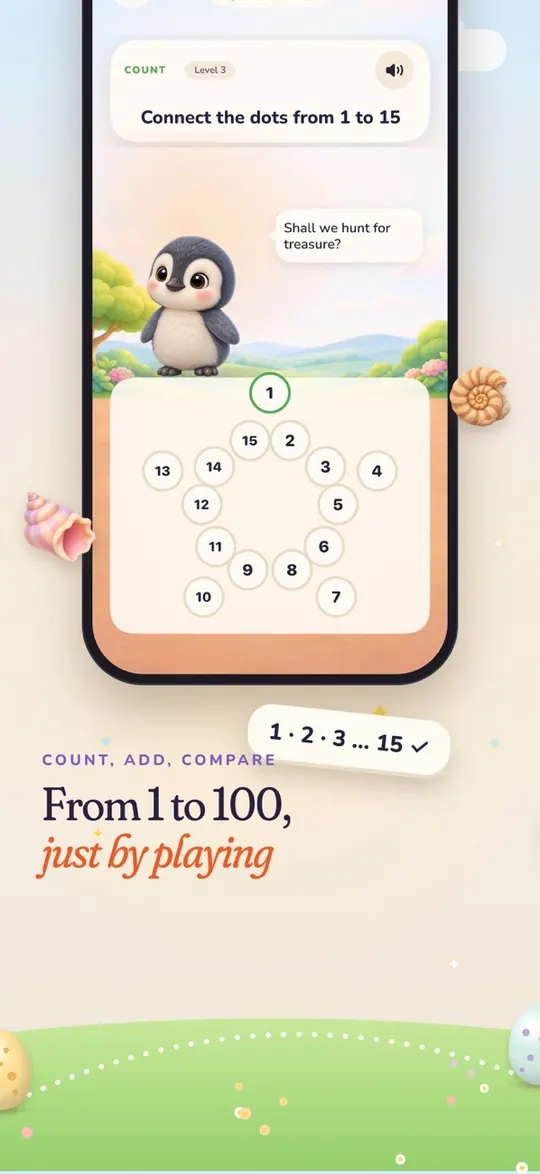
Nidada includes finger writing and at-a-glance counting games. Don't force perfect number formation when the goal is to understand what a quantity means. Switch between fingers, blocks, drawings, and symbols. The What Works Clearinghouse recommends a developmental progression for teaching numbers and operations to young children. The app offers levels, but an adult can select a slower pace when an idea is not yet fully grasped.
Early primary years: adding and subtracting with understanding
Represent 4 + 2 with four objects and two arriving. For 6 − 2, remove two and observe what remains. Then use a number line to show jumps forward and backward. A child may respond correctly by touching a bubble through trial and error; asking them to explain the action reveals more. Create short problems about snacks, toys, or walks, and change the objects to check that the relationship holds.
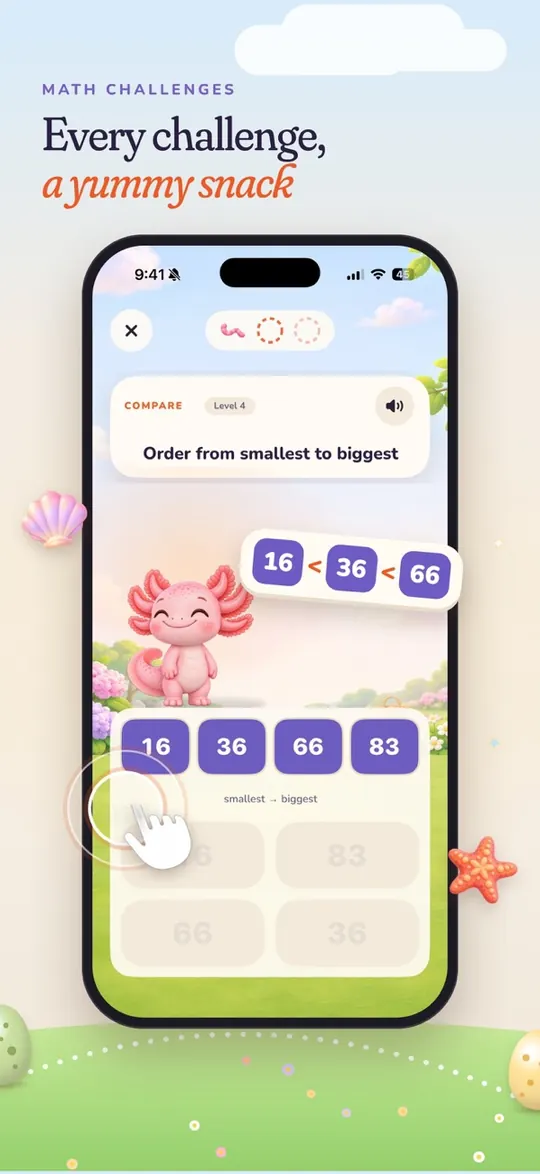
The Nidada app listing mentions blocks, a number line, word problems, and an automatic difficulty adjustment. If a challenge fails, it offers a hint and explanation, and returns to it later based on its description. The combination can support practice, but the child needs to connect each image with the operation. Not all children progress to written calculations at the same rate. If the activity becomes too difficult, the adult can adjust the pace and look for a concrete example of the same idea.
Consolidation: tables and place value
Multiplication tables make more sense when equal groups are understood. Form three groups of four pieces, count to twelve, and ask what each number represents in 3 × 4. Memorization later can make calculations easier, but it doesn't replace that structure. For two-digit numbers, group ten pieces as a ten and leave out units. A mini-game of building numbers with blocks can help visualize this if the child explains what changed when adding a group of ten.
The announced curriculum up to fifth grade includes multiplication tables and word problems, although the app listing doesn't specify the exact order of each skill. Don't promise a curriculum identical to that of every school or country. A child who has mastered multiplication tables may need more practice deciding when to multiply in a word problem. Change the wording and ask them what information they know, what question they are asking, and how they would check a reasonable answer.
The game helps when the mathematical idea is understood
A screen can teach counting, but the goal isn't just to tap the correct answer. Ask the child how they knew how many there were or what changed when a piece was added. If they use fingers, drawings, or blocks, they're making their reasoning visible. The Education Endowment Foundation recommends connecting manipulatives with pictures and symbols, rather than expecting a pretty representation to teach on its own. A coin-tossing minigame can spark a conversation about quantities; a digital clock can lead to looking at a physical one.
Nidada offers more than fifteen games according to its app listing, but you don't need to try them all in one session. Choose one that corresponds to a specific skill, observe two or three attempts, and then look for an example off-screen. If the activity is too difficult, lowering the difficulty level allows you to grasp the concept without turning it into a race. If it's too easy, ask for a verbal explanation or change the challenge. Fun and clarity can coexist when the family allows space for reflection.
Clues, mistakes and your own rhythm
The Nidada app listing states that the difficulty increases when the child succeeds and decreases if a task is difficult; an adult can adjust the pace. Mistakes reappear later, and there are hints and explanations. This describes the app's design; it does not guarantee an identical learning outcome for everyone. When observing a mistake, avoid simply saying "try again." Ask if the child confused the symbol, counted a square twice, or didn't understand the story. Then use objects or a drawing to check.
The What Works Clearinghouse recommends systematic instruction, clear mathematical language, representations, and explicit work with word problems. A digital hint can model a step, but an adult can check if the child understands why it works. If they get it right after seeing the solution, offer another similar example before saying they've mastered the topic. If they get frustrated, they should stop the game and come back later. Automatic adjustment is an aid in selecting tasks, not a diagnostic tool for school skills.
Clock, coins and fractions in context
For telling time, start with everyday moments: what time an activity begins and how much time is left. For coins, represent simple payments using values in your currency, checking the app's location. For fractions, divide a sheet of paper or a piece of cardboard into equal parts and explain what the whole represents. The Nidada app listing suggests games related to these three areas, which require different vocabulary and representations. Don't assume that knowing how to add implies understanding half.
A child can recognize the image of a clock without knowing how to relate the hands to the passage of time. They can count coins but confuse the number of pieces with their value. They can color a shape without checking that the parts are equal. Use mistakes to choose a clearer example, not to increase speed. Repeat the idea in a real-life situation and compare what remains the same when the drawing changes.
Adapting a session to the real child
Select a skill, observe a couple of attempts, and ask if the child wants to continue. On the app listing, the difficulty is adjusted based on successes and mistakes, and the adult can modify the pace. This helps prevent a sudden jump, but it doesn't, by itself, indicate the appropriate grade level. Progress by skill is an internal record for deciding what to practice. If a fractions game is done by trial and error, return to objects and pictures before moving on to the next level.
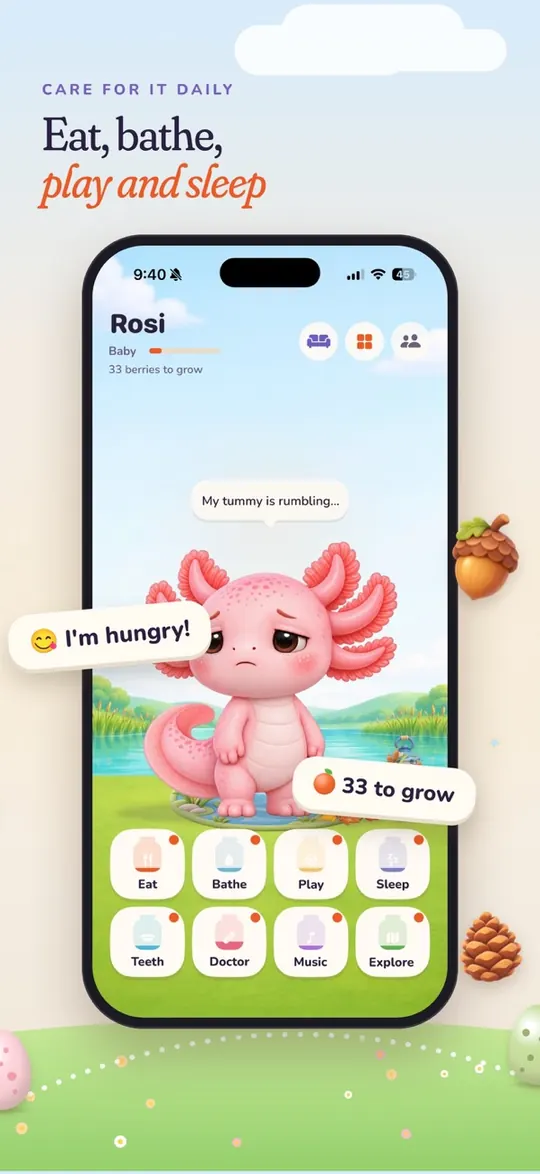

The pet may require care in different settings, such as bath time, a park, or an outing. This is a reason to play, not an obligation to complete a checklist. Agree on an end to the session even if another activity is available. Afterward, jot down a question for the teacher if you observe a persistent difficulty. The variety of fifteen skills is useful for exploration, but continuity should be based on understanding, interest, and rest.
What access includes and what you should check
The App Store listing indicates a free download with in-app purchases: without a subscription, there are free games every day; Nidada Completa allows unlimited play through a monthly or annual subscription, with a three-day trial for the annual subscription, according to the description. Terms and prices vary by region and are subject to change.
The listing also states offline functionality, no ads, and a protected adult area with skill-based progression. Apple indicates that the statement about not collecting data comes from the developer and has not been independently verified.
A small routine at home
Try a short session when the child is in the mood to play, not as a reward for finishing homework. Let them choose a pet and a task; when they finish, ask what they did and apply the same idea to an everyday situation. If they played at paying with coins, set up a small market with toy coins. If they drew fractions, divide a sheet of paper into two and four sections. If they told time, look at a clock at home. This way you can see if they recognize the concept in another context.
Nidada's care activities—feeding, bathing, sleeping, toothbrushing, outings—can motivate a child to return, but they shouldn't turn the practice into an endless obligation. Agree on a time to put the device away, even if the pet asks for something else. Progress shown in the adult area helps decide which activity to repeat, not label the child. If a math difficulty persists and affects school, share specific examples with their teacher to choose appropriate support. An app is a companion; it doesn't replace teaching or conversation.
Frequently Asked Questions
Is there a specific age for each minigame?
No; observe what the child understands and adjust the difficulty level.
When should multiplication tables be introduced?
After exploring equal groups and the meaning of multiplication.
Does voice playback allow you to play without reading?
Read-aloud instructions can help, but an adult may need to explain the vocabulary.
Does the app cover fifth grade?
The app listing lists content from preschool through that grade, without guaranteeing alignment with each local curriculum.
How many levels does it include?
The app listing announces more than sixty levels spread across fifteen skills.
Sources and scope
Nidada features and access according to its official listing on the Spanish App Store. For the use of materials and drawings, consult the Education Endowment Foundation; for instruction, language, and problems, consult the What Works Clearinghouse. Check current terms and conditions in each store. The app is a practice tool and not a school assessment.