Best potty training apps: a considered comparison of 5 options
Transparency: Adiós Pañal is made by AppRadar, the publisher of this website.

Adiós PañalPotty Training
The best apps for potty training are those that help track and coordinate progress without pressuring the child. In this editorial selection, Adiós Pañal takes first place for combining reminders based on progress, plans, kid mode, resources for caregivers, and an optional one-time payment; the choice depends on each family.
How we ranked these five apps
This ranking compares the information described in official App Store listings: ease of logging events, clarity of reminders, child participation, communication between caregivers, free access, and cost. The first position reflects the combination of these criteria, not clinical proof that an app achieves potty training faster. Availability and price may vary by country. Check compatibility, language, and privacy before installing.
We do not consider a single review as evidence of effectiveness. Adiós Pañal shows a score based on a single review in the Spanish listing consulted; this sample does not allow for comparison of results. The claims in other listings are also statements from their developers. Distinguish between advertised features and proven experience. If an app includes a guide, it does not mean it replaces a paediatrician. The best practical criterion is whether it helps adults calmly support their specific child.
1. Adiós Pañal: logging, reminders and coordination
The Adiós Pañal app listing allows you to record pee, poop, potty attempts, dry checks and accidents; it includes reminders that restart after each pee, seven- and fourteen-day plans, a kid mode with voice and stickers, stories, and a caregiver card. We think it's the most complete option for a family that wants to integrate routine, record-keeping, and celebration without penalizing accidents. It doesn't require an account and doesn't display ads, according to its listing. It's available in numerous languages.
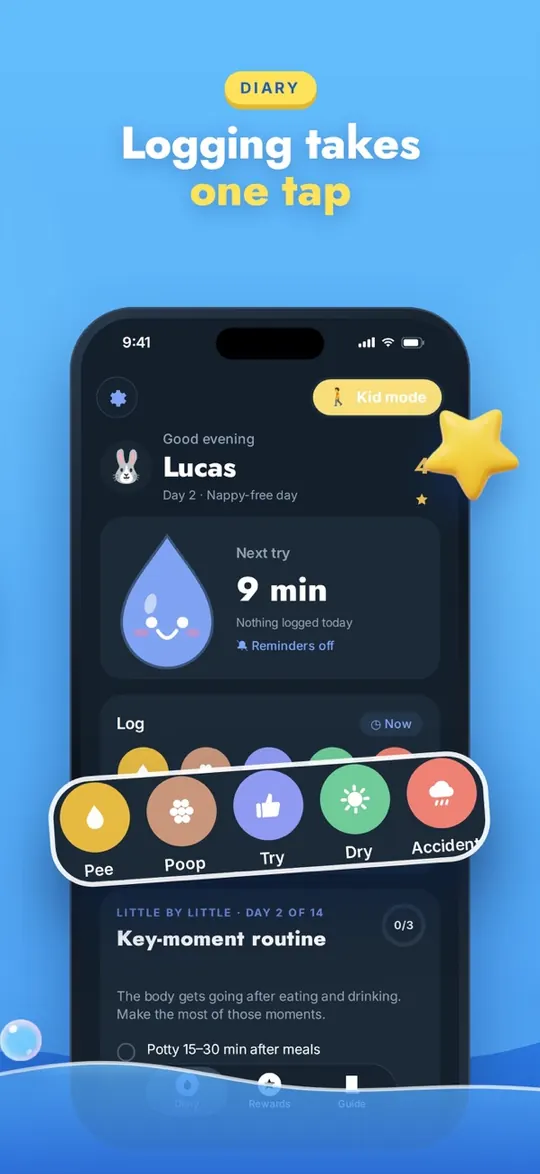

The download is free, and Plus is offered as a one-time purchase without a subscription. Plus adds an intensive plan, dry nights, a PDF report, more content, and support for multiple siblings. It's not necessary to purchase it to prepare a child, nor does the intensive plan guarantee success in three days. Check which tools are available in your version and whether your child enjoys kid mode. Its alerts depend on actual data and should be adjusted when there are schedule changes. Official Adiós Pañal listing.
2. PottyDay: Several caregivers with their phones
PottyDay features a pee, poop, and attempt log, stickers, a timer, a seven-day starter guide, and a one-time family payment option. Its listing states that up to six caregivers can log from their own phones and sync data. If many people take turns caring for the child, this collaborative feature could be the deciding factor. It claims to require no registration and display no ads. Official PottyDay listing.
It's worth checking exactly what "sharing without an account" means, what data is synced, and how access is revoked. A family that prefers to keep everything on a single device might not need this plan. The most attractive screen doesn't replace agreeing on what to do in case of an accident or refusal. It ranks second for its emphasis on coordination between devices, a different need than the storybooks and kid mode of Adiós Pañal. Check current language, purchases, and compatibility.
Signals matter more than a date
The decision to start potty training doesn't depend on your child turning exactly two or three years old. Observe whether your child notices wetness or the need to urinate or defecate, shows curiosity about the bathroom, can participate in lowering their clothes, and is willing to sit for a few moments without distress. Some signs appear earlier than others, and it's not a test that should be passed in a day. The American Academy of Pediatrics describes readiness as a combination of physical development, understanding, and emotional readiness. Talk to your paediatrician if you have any particular needs or concerns about your child's development.
The Spanish Association of Pediatrics explains that toilet training is usually established around two to three years of age, with individual variation. This age is a general guideline, not a strict deadline. Using simple words, showing the child where the potty is, and allowing them to observe the routine can precede any potty training. If the child responds with strong resistance, returning to a familiarization phase may be more helpful than increasing the frequency of reminders. Technology does not create a physical skill that is still developing.
Accidents, rewards and respect
An accident provides information about the moment, the context, and the available clothing. It's not a moral failing. Clean up calmly, offer a change of clothes, and continue with the routine without taking away rewards already earned. The Adiós Pañal app listing explicitly states that accidents don't deduct stars and that every attempt counts. Their system offers experience rewards chosen by the family, such as selecting a storybook or going to the park. This choice allows them to celebrate the effort without turning toilet learning into a competition for objects.
HealthyChildren, from the American Academy of Pediatrics, explains that daytime accidents can continue for months even after apparent progress. If they are very frequent, do not decrease, or are accompanied by discomfort, it is advisable to consult a paediatrician. Do not force the child to sit for long periods or punish them for wet clothes. Ask if they want to try, offer help, and pay attention to their response. A chart may show patterns, but a graph does not define a child's worth or replace observing how they feel.
3. Potty Path: Plan and Library of Situations
Potty Path advertises a personalized daily plan, stickers, a child mode, reminders, milestones, and a library of tips on situations like fear of the toilet, travel and stool withholding. Its description also includes a card for sharing the routine. It can be helpful for those looking for many organized ideas and a visual guide. The child's data is advertised as being saved on the device. Official Potty Path listing.
The breadth of a library doesn't mean every answer will work for your child. For constipation or pain, use the general information only as a starting point and consult professionals. Check which parts of the plan are included for free and how to access paid features. We've ranked it third for its variety of situations and content, but a family looking for only a simple log might prefer another option.
4. Potty Training Coach: Adult Routine
Potty Training Coach focuses on displaying the next potty opportunity, recording in just a few taps, and noting whether the child requested to go alone or received an invitation. Its reminders are optional, and its description indicates that caregiver data and notes remain on the iPhone and are shared manually. It may suit adults who want a discreet tool without games for the child. Official Potty Training Coach listing.
Its listing advertises weekly and annual subscriptions; check the price and availability of the free version before deciding. The fact that it says no account is required doesn't automatically mean it has all the features without paying. It comes in fourth because the ranking also prioritizes children's participation and the one-time payment option. If a clean interface and context logs are more important to you than stories or stickers, your personal ranking might be different.
5. Potty Toilet Training: Stickers and Collaboration
Potty Toilet Training, by Francois Duchemin, includes a visit log, stickers, configurable reminders, a memory game, and options to share with another caregiver via iCloud, according to the listing. It's an alternative for those who want a familiar timer and synchronization with the Apple ecosystem. The Spanish listing shows a purchase price; please confirm it before paying. Official Potty Toilet Training listing.
Its presentation is primarily in other languages according to the listing, so it's advisable to check the experience in Spanish before purchasing for a Spanish-speaking family. iCloud backup can be useful, but it requires reviewing account settings and permissions. The fact that a listing includes testimonials of quick results doesn't prove that all children will learn the same way. We ranked it fifth based on language and access model for this audience; not because its log lacks value.
Which option to choose based on your family
If you want a guide in Spanish, flexible reminders, and celebrations for your little one, try Adiós Pañal. If six caregivers need to add events from different phones, check out PottyDay. If you're looking for a situation library, review Potty Path. If you prefer an adult calendar without a child mode, compare Potty Training Coach. If you already use iCloud to coordinate, explore Potty Toilet Training. This matching helps more than accepting number one as a one-size-fits-all answer.
Try a week of actual use first. Ask if the child is comfortable, if reminders are dropped when the child says no, and if the adults record without being obsessive. Don't buy a plan to meet a school deadline if the child isn't showing signs yet. Consult the paediatrician for pain, constipation, or retention. The ranking orders digital tools; the learning experience belongs to the child and their caregivers.
Poop, constipation and consultation
Learning to pee and learning to poop don't always progress at the same pace. Some children ask for a nappy to poop, become tense, or try to hold it in. Pain and constipation can complicate the experience; an app that alerts more often won't solve the problem. Consult your paediatrician if there is pain, hard stools, retention, blood, persistent discomfort, or concern about bowel habits. Describe what is happening and when it started, rather than trying to impose a deadline.
The AAP notes that constipation can occur during this stage and recommends individualized guidance for its treatment. Specific advice on continuing, pausing, or modifying training depends on the symptoms and a professional assessment; it should not be reduced to a one-size-fits-all rule found online. If you keep a record of urination, defecation, and attempts, you can show a helpful summary during a consultation. Adiós Pañal advertises a PDF report for the paediatrician within Plus, but the report does not provide a diagnosis.
What the app does and what it doesn't promise
The App Store listing presents Adiós Pañal as a tool to help track pee, poop, attempts, dry moments, and accidents with a single tap. It describes reminders that count again after each pee and adjust to the recorded rate, seven-day preparation and fourteen-day gradual plans, a kid mode with large buttons, stories and stickers, and a caregiver card. Check the exact availability of each feature and its language in your app store. The Android download link is provided, but the features listed here are from the iOS listing.
An app cannot tell if a child is ready just by the time between two check-ins. Entries may be incomplete when caring for others, during an outing, or at night. Use the reminder suggestion as a flexible prompt, not as an order to sit down a resisting child. If the schedule changes due to illness, vacation, or school, adjust the plan. The goal is to help the family share a consistent routine while the child becomes more independent at their own pace.
Privacy, access and paid version
The iOS listing states that no account is needed, no ads are displayed, and data is stored on the device. Apple clarifies that the privacy information is declared by the developer and is not independently verified. Avoid sharing screenshots with the child's name, schedules, and other data on public networks. If you change phones, check beforehand how the history is stored. The caregiver card can be helpful, but only share what is necessary with the people involved.
Adiós Pañal is a free download with in-app purchases. The listing describes Plus as a one-time payment, without a subscription, that adds the three-day intensive plan, the dry nights plan, more comprehensive guides and reports, multiple siblings, and additional content. Don't interpret "three-day plan" as a promise to eliminate nappies within that timeframe. Prices and content may vary by store and date. Before paying, try the basic tools and decide if the expanded material meets a real need for your family.
Frequently Asked Questions
Which one is in first place?
Adiós Pañal, for the editorial combination of logging, reminders, kid mode and caregiver coordination.
Can an app guarantee potty training?
No. Preparation and support matter more than the application timeline.
Are there any options without a subscription?
Adiós Pañal Plus and PottyDay Family are described as one-time payments on their listings; please check current terms and conditions.
Which app facilitates multiple caregivers?
PottyDay announces phone synchronization; Adiós Pañal offers a sharing card.
When is it appropriate to ask for help?
If there is pain, retention, constipation, or persistent accidents that concern you, consult your paediatrician.
Sources and criteria
App features according to the official Adiós Pañal listing on the App Store. For development and preparation, consult the Spanish Association of Pediatrics and the American Academy of Pediatrics. Regarding accidents and constipation, the HealthyChildren guides offer general guidance. Check dates, conditions, and language for each listing; this guide is not a substitute for a paediatric evaluation.