What reading comprehension questions can you ask your child about a story?
Transparency: Letruga is made by AppRadar, the publisher of this website.
Start with something that happened in the story, such as "What did the character want to achieve?", and listen to the answer before choosing another question. If your child remembers the action, invite them to explain a cause or point to a clue on the page. If they struggle to answer, reread the scene and allow them to show you with a gesture, a drawing, or their own words.
Before reading, choose what's worth talking about
Open a storybook that your child would like to listen to or read with you. Think about what's interesting about the story. Perhaps two characters see the same situation differently, or maybe a small detail on the first page makes sense at the end. Choose one of those aspects. It will be easier to talk if there's something you'd also like to understand or discuss.
The cover offers a good starting point when it sparks curiosity. If it features a closed box, you can ask, "What would you like to know about that box?" The child's response will tell you where their attention is drawn. If they want to open the book immediately, start reading. You can return to the cover when you finish and see if the picture means something different after learning what was inside.
Also adjust who will read. If the text requires an effort that prevents him from following the scene, read aloud yourself and let him participate in the conversation. Another day you can use a story he can read on his own. To choose one, consider its length, the letters he knows, and what he's interested in. You'll find more ideas in the guide to short stories for children who are beginning to read.
During reading, ask a question at a point where something changes
Imagine a character is carrying a blanket into the garden. It starts to rain, and the character runs back. If you stop the story there, you already have something to figure out together. “What happened just before they came back?” invites you to recall a fact. “Why do you think they came back?” asks you to connect two facts. Choose one of the two based on what your child has already said upon seeing the picture.
A question to retrieve what the text says
Literal questions have answers that can be found on the page. You can ask who arrived, what they were carrying, or where they left something. Choose a detail that's necessary to follow the story. In the blanket scene, knowing where it was helps to understand why the rain matters. The exact color of an item of clothing might only be worth noting if it later allows you to identify someone.
A question to connect clues
Sometimes a story leaves a cause unstated. If your child thinks the character ran because they were cold, listen to their explanation. Ask, "What did you see or hear that made you think that?" Perhaps they'll point to how the character is hugging themselves in the picture. Perhaps they'll remember a phrase from earlier. Let them draw on one of these clues and work together to see if it fits with the rest of the scene.
If the story is approaching an exciting moment, let it continue. You can remember the location by placing a piece of paper between the pages and returning there later. You can also make a brief comment and wait: "I was surprised that they left the blanket." Your child may want to finish the thought or may prefer to find out what happens on the next page. Both options keep the conversation open.
After reading, help him explain what changed
Try starting with their favorite part. If they choose the ending, ask them to remind you how the character got to that point. It's a more concrete invitation than asking them to recount everything from the beginning. If they need support, open two pages, one from the beginning and one from the end. Ask what the character now has that they lacked before, or what they can do now that they couldn't before.
To reconstruct a story with your hands, fold a sheet of paper into thirds. Let your child draw what the character wanted, what got in the way, and what they did in the end. They can use a simple line for each moment. Then, go over the drawings together and let them tell you what happened. If an important part is missing, open the story to that scene and invite them to decide where it would go.
Not all stories have a problem to solve. If you've read one with a series of visits, sounds, or discoveries, you can put three of those encounters in order. If it's a circular story, look again at the first and last illustrations. What is repeated? What can you recognize at the end that went unnoticed at the beginning? Choose a question that respects the way the story is told.
What to do when they answer "I don't know"
Reduce how much your child needs to recall
Change "What happened in the story?" to "He just left home. What is he carrying?" Reread the corresponding sentence and leave the page open. If he points to the object, accept the gesture as an answer. You can put the gesture into words yourself and continue the conversation. To expand on this, ask him what the character did with that object a little later. Now you have a concrete point from which to continue.
Show how you look for an explanation
Choose a genuine doubt and think aloud. For example: “I thought she was going to leave the blanket outside. It says here that she folded it and took it with her. Now I think she wanted to keep it dry.” You’ve shown which part of the story made you change your mind. Invite them to share if they imagined the same thing. They can disagree and look for another clue, or simply ask to read the ending again.
Offer them another way to respond
Two toys can represent the characters. Ask your child to show you with them who arrived first and who was waiting. A single movement can clarify a relationship that was difficult to explain in one sentence. If you speak several languages at home, your child can begin telling you the story in their preferred language. Then you can go back together to the expression the story used for that same action.
How to choose the next question based on your child's answer
If they respond with a fact, you can explore the cause. If they offer an explanation, look with them for something on the page that supports it. And if they tell you about a personal experience, acknowledge the connection and naturally return to the character. For example, after hearing them describe when they got wet in the rain, you could say, "You looked for somewhere to take cover. What did the character decide to do with their blanket?"
It's also worthwhile to let your child ask the questions. Close the book, leaving a finger on their favorite page, and tell them it's your turn to answer. If they ask a question you don't know the answer to, go back to the text together. If the story never says what they want to know, you can imagine two possibilities and distinguish what they invented from what actually appears in the story.
If they choose to read on a screen, Letruga includes stories with questions and recorded voiceovers. Once your child answers, you can ask them to return to the scene that gave them the idea. If they prefer to continue reading, save the conversation for the end. The stories they see in the app are made up of letters they have already learned.
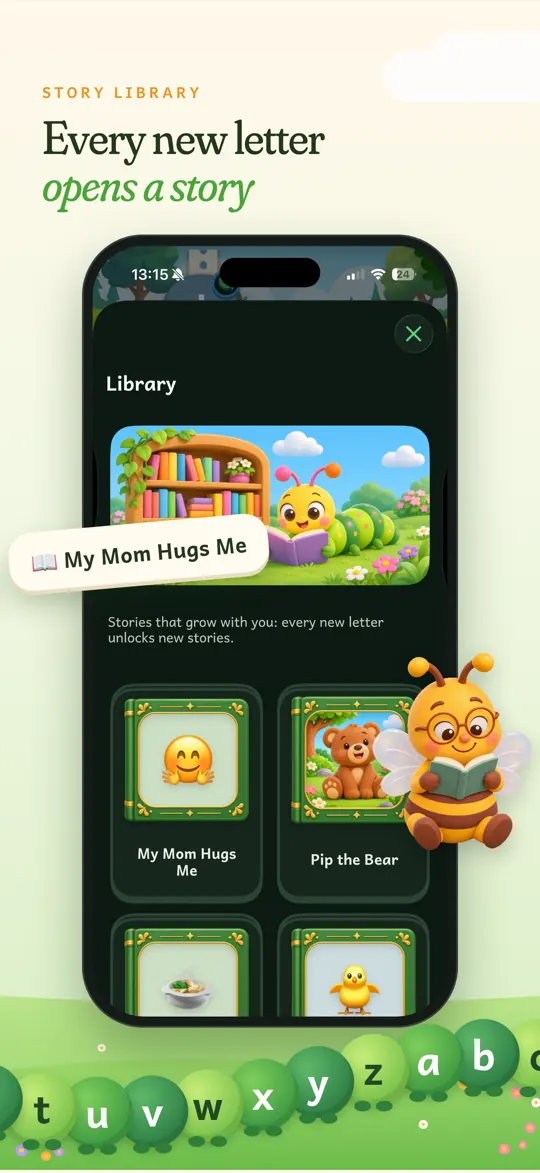
Letruga is an app from AppRadar, the publisher of this website. It's designed for children aged 3 to 7. It's free to start, with in-app purchases, and is available for iPhone and iPad on the App Store and for Android on Google Play.
When to share your observations with your child's teacher
If your child often struggles to recount what happened even after hearing a short, familiar story, talk to their teacher. Describe what they understood on their own, what question you asked them, and what changed when you turned back to the page. Also mention stories they do enjoy discussing. These are concrete examples that allow you to compare situations and choose a way to support them in the next reading.
Frequently Asked Questions
How many questions should you ask per story?
You can start with a single question that sparks a conversation. If your child remains interested, listen to what they add and build from there. In a short story, a brief exchange after the ending might be enough to revisit the most important scene.
Does a personal opinion count as understanding?
Children can show understanding when they connect their opinion to something that happened. If they say the character was kind, invite them to recall what the character did to help someone. This will help you understand the moment that led to that interpretation.
What do I do if they remember the illustration differently?
Look at the page together and let them find the detail. Then reread the related sentence. They might discover that one thing appeared in the image and another in the text, or that they were remembering a later scene.
Can I use these questions if he/she is not yet reading independently?
Yes. Read aloud and discuss what they've heard. They can point to a character, predict an action, or reconstruct the ending. If you want to observe their understanding when they read independently, choose a text they can read another time.
What if he invents a different ending?
Give him space to tell his story. Afterward, you can ask him where his version diverges from the one you read. Find that page and ask him what he would change from there. You'll have the book's ending and one he created.
Sources
- Reading Rockets. Strategies to accompany comprehension at home.
- Reading Rockets. Family activities to reconstruct a story.
- Reading Rockets. Retelling questions.