Short stories for beginning readers: three decodable texts
Transparency: Letruga is made by AppRadar, the publisher of this website.
Short stories for beginning readers are most useful when they use letters and sounds that have already been taught, keep sentences short and invite conversation about what happens. These three original stories follow the letter order of Letruga’s English course, and each one comes with the list of letters it needs, so you can choose the right level; an adult can read the rest of the page.
How to choose a story your child can decode
A first story doesn’t have to use only two-letter words, but it should let the child apply what they know. Check the list of letters before handing it over. If your child doesn’t know a letter yet, read that word yourself or choose another text; don’t ask them to guess it from the picture. The aim is to practise blending sounds, not to measure speed.
The EEF supports explicit, systematic teaching of letter–sound correspondences, and the same organisation stresses building comprehension and language alongside decoding. That’s why every story on this page comes with a spoken question. The answer can be a short sentence, a gesture or a drawing; the adult can keep the conversation going beyond that question.
In Spain, for example, the early years curriculum describes a playful approach to texts and respect for each child’s pace. These stories are optional extras, not milestones every child must reach by a certain age. The Spanish paediatric association AEPap encourages reading aloud together: children can enjoy far more complex stories when an adult reads them.
Story 1: An Ant in Tim’s Pants
Letters needed for this story: s, a, t, p, i, n, m and d, the first eight sounds of Letruga’s English course. Capital letters at the start of sentences and names, an apostrophe and full stops also appear; an adult can point them out. Your child doesn’t need to know the whole alphabet. If the school teaches these letters in a different order, wait until your child has learned them.
Tim and Dad sat in sand. Pip, an ant, sat in Tim’s pants! Tim did a mad spin. Dad pats Tim’s pants. Pip sits in sand.
Read one sentence at a time and point to the letters, without sliding your finger so fast that your child can’t blend the sounds. When they finish, ask ‘Who sat in Tim’s pants?’ The answer is in the text: Pip, the ant.
You can act out the scene with a toy figure and a pretend ant. Then try a variation made with the same letters, such as Pip naps in Dad’s pants. If your child reads it without having memorised it, they are applying letter–sound links. The story is deliberately tiny: the meaning grows in conversation, when your child imagines where Tim and Dad are and how they feel.
Story 2: A Pig in Nan’s Pot
Letters needed: those from story 1, plus g, o and k. The text includes names and punctuation that you can explain aloud. Follow the school’s sequence; don’t move on to the second story just because your child has finished the previous screen.
Nan’s mint is in a pot. Dot, a pink pig, digs in it. Dig, dig, dig! Nan spots Dot. Nan pats Dot, and Dot naps.
Ask ‘Who digs in the pot?’ and then ‘What does Dot do at the end?’ The second question means going back to the last sentence. If spots is new to your child in this sense, explain that here it means ‘sees’; they can point to something they spot in the room or draw the scene.
This story helps you tell decoding apart from understanding. Your child may read spots by blending the sounds and still think of the spots on a ladybird. That doesn’t cancel out the reading effort: a quick explanation and a second reading build understanding. You can also read the first sentence yourself and ask your child to read the next, taking turns.
Story 3: Mick and Kit Pack a Sack
Letters needed: all the earlier ones, plus c and ck. In English the same sound can be spelled k, c or ck; in this story ck only comes at the end of a word, as in Letruga’s course. Before you start, check that your child has learned that c, k and ck all stand for that one sound.
Mick and Kit pack a sack. Mick packs a cap and a sock. Kit packs a map. Kit tips it! A cap, a sock, a map… and a cat!
Ask ‘What does Kit pack?’ and ‘What else is in the sack at the end?’ Don’t answer both questions with the same picture: go back to the order of the sentences and point out that the story changes when Kit tips the sack out.
To act it out, draw a cap, a sock, a map and a cat on four cards. Ask your child to put the actions in order after reading. If they don’t know ck yet, read sock and sack yourself, or go back to an earlier story until that spelling and those words have been practised. A controlled text can include some adult help without becoming an all-or-nothing test.
Checking the letter inventory
The words of the first story use only the eight letters listed, ignoring capitals and punctuation. The second adds g, o and k; the third adds c and the ck spelling. The instructions and the adult’s questions use other letters, but they are not part of the text the child is asked to read. Keep that distinction in any printed version.
Words with other spellings, regional pronunciations or another language’s conventions need a fresh check. Translating sopa or queso from the Spanish stories would not keep the same letter inventory in English. That’s why each language version of this guide has its own stories, written with the letter order of Letruga’s course in that language, rather than translations of the Spanish ones.
When you lay out a page, put each story in its own box and place the letter list just before it. Don’t put a long title in the independent reading area if it brings in letters the child doesn’t know yet; an adult can read the heading and the question. If you add pictures, use them to talk after the reading attempt, not to guess the story.
How to read together without turning it into a test
Read the title aloud, choose one sentence and give your child time to point to the letters and blend the sounds. If they stop, model part of it and hand the turn back. A session can end after a single sentence. There’s no need to finish all three stories in one go or reread them until everyone is tired.
After the comprehension question, invite your child to imagine something else: Where else could Pip the ant sit? What else could Dot dig up? What would you pack in a sack? Open questions like these build vocabulary and bring the controlled sentences to life. There are no right or wrong answers here, as there would be on a worksheet.
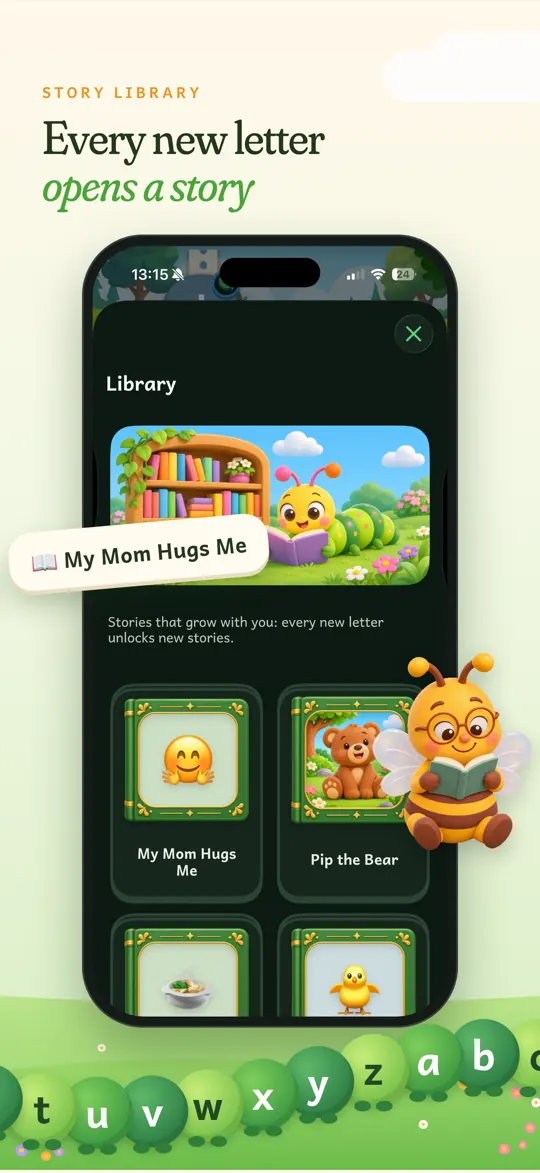
Letruga’s English course has 10 stories that unlock as letters are learned, each ending with a question. The three stories on this page are original material from this website, not stories taken from the app. You can use them as extra practice on paper once you have checked which letters your child knows.
A bookshelf with two kinds of books
Decodable stories let a beginning reader practise what they can decode. Picture books read by an adult offer richer vocabulary, varied sentence patterns and room for imagination. Keep both: one kind for building independence, the other for enjoying a story without the limit of known letters. The EEF sees language and comprehension as inseparable from learning to read.
The AEPap highlights the value of shared reading, favourite stories read again and again, and family conversation. If your child asks for the same story for the fifth time, go back to it without worrying. If they would rather you read, let them follow along and join in on a word they know. Enjoying books is progress too.
If you notice an ongoing difficulty recognising or blending sounds, take a specific example to the teacher. Don’t read a diagnosis into one story. Adjusting the text and getting advice can help more than hunting for a bigger collection.
How to extend a story without breaking its level
After a few readings, invite your child to make up a new sentence aloud. Before adding it to the text they read on their own, check every letter and letter group. If an unknown one appears, write the sentence for an adult to read or save it for later. That way the stated letter inventory stays intact, while your child’s imagination can go well beyond what they can decode alone.
Rereading doesn’t have to be identical every time: you can take turns reading, put cards with the actions in order or invent a spoken ending. A new activity around the same story helps you check understanding and keeps the pleasure of sharing stories. Once your child has learned more letters, choose a new story with a bigger inventory.
Frequently asked questions
Can a child who only knows s, a, t and p read these stories?
Not on their own yet: the first story also needs i, n, m and d. An adult can read it aloud.
Are the three stories from Letruga?
No. They are original texts written for this page. The app has its own library of stories that grows as the child learns letters.
What if a word contains a letter that hasn’t been taught?
Read it yourself, explain the letter–sound link if it helps, or choose a story with a better-matched inventory.
Can the stories simply be translated?
No. Each language version has to check sounds, spellings, words and decoding level in its own language.
Why ask questions after reading?
To check and deepen understanding, as well as to practise decoding.
Sources
Revised on 11 November 2026. Spanish Ministry of Education, early years curriculum; EEF, phonics; EEF, early reading; AEPap, shared reading; Letruga on the App Store. The practical recommendations are editorial. Features, prices and languages may change: check your store listing before paying.