How to teach your child to read syllables if they already know the letters?
Transparency: Letruga is made by AppRadar, the publisher of this website.
Choose a syllable made up of letters whose sounds your child already knows. Point to each letter as you say its sound and slide your finger underneath to show how the sounds blend together. Then follow the same path together, using your voices and fingers at the same time, before inviting your child to try on their own.
What does your child find difficult when moving from letters to syllables?
Perhaps your child recognizes a letter on a sign, says its name, and even knows how to write it. When they find it next to another letter, they name both again and look at you, waiting for a clue. To know how to help them, listen to what they do with a single letter. Ask them, "What sound does this represent?" If they give you the name, acknowledge their success and make the sound they need to read.
If he's already saying both sounds, listen to what happens between them. Does he pause for a long time? Does he repeat the second sound and forget the first? At that point, you can put the paper away and say both sounds yourself, first slowly and then together. Invite him to imitate you. By removing the letters for a moment, you can focus all your attention on how he blends them with his voice.
Show them the written text again and point to the location of each sound. This connects something they just heard with something they can see. Reading Rockets suggests combining oral activities with letters once the child understands the relationship between those letters and their sounds. If you want to understand how this step fits into word reading, consult the guide to the sounds and syllables method.
How to choose a first syllable to practice
Think of a word your child uses when speaking that contains a short syllable you can identify. Write that syllable separately, using the letter shapes your child usually reads. Say it yourself before showing it to them. If you would need to explain a new rule for them to know which sound a letter represents, save that option for another day. Today, you are introducing just one new task: blending the sounds.
For the first demonstration, it may be helpful to start with a sound that you can sustain naturally. This way, you can move on to the next sound while moving your finger. If the sound is short, pronounce it for its usual duration and then immediately move on to the next one. Listen to yourself once before starting. If you lengthen a sound by adding a vowel, your child will hear a part that they won't find written down later.
Simply write on a piece of paper that you can both see clearly. Leave room below the letters to move your finger without covering them. If your child is already practising at school, you can use a syllable from a text they have brought home. You will have a familiar example, and you can ask how their teacher points out the sounds so you can use a gesture your child recognises.
How to show him/her voice and finger movement
First listen to how you do it
Sit next to them so you both see the letters in the same direction. Say, "This time I'll read. Watch my finger and listen." Start under the first letter and move to the next in the reading direction of the language. Coordinate your voice with your movements. When you finish, go back to the beginning and pronounce the entire syllable in your natural speaking voice.
Then read together
On the second round, let him move his finger while you speak. Adjust your pace to his so he can connect what he's pointing to with what he's hearing. Then switch roles. You move your finger and let him start reading. If he stops in the middle, go back to the beginning and do the whole thing together. You can say, "Start with me and go up to here."
When your child wants to try alone, move your hand away and give them time to begin. If they blend the sounds, acknowledge the specific action: “This time you said them without a gap.” If they ask whether they did it correctly, answer clearly. Then you can write the same syllable elsewhere on the paper and invite them to read it there. This gives them another chance to follow the letters on their own.
Three games to combine sounds at home
The echo with two voices
Choose a syllable from a familiar word. Say its sounds slowly and ask your child to act as an echo by blending them together. In the first round, you can play both roles yourself so they hear how the game works. Then let your child lead a round while you act as the echo. To finish, write down what you have just said and read it once together, following the letters.
Two cards approaching
Write the letters they are going to read on two cards and place them in order with a small space between them. Point to each card and say the corresponding sound. Ask your child to bring the cards together until they touch. At that moment, run your finger under both cards and read the syllable. On their turn, they can prepare the cards and ask you to read what they made.
A label for an object
Choose two household objects whose names they know and can read using the letters they have practiced. Write the name of one on a label and set both objects aside. Read the label first, blending the sounds, and then the whole word. Then bring the objects closer and let them place the label where it belongs. For another round, they can choose which object you will label.
What to say when he stops or guesses
If your child says the letter names, you can reply, “Yes, those are their names. Listen to the sound the first one makes here.” Give them that sound and read with them again. If they pronounce both parts correctly and then ask what they say, change the help you offer: “You already have both sounds. I will say them with you, without a gap.” Repeating the original question would give them little to work with. Let them hear the step they are missing.
If they guess the word by looking at the picture, ask them to show you where what they just said begins. Follow along with your finger to the point where their reading diverges from the written word. Say the sound that appears there and read the whole word again. Then you can look at the illustration and talk about what it represents. Each part of the activity thus has its own time.
If he puts the paper away or tells you he's tired, you can finish reading to him and let him choose what to do next. If he continues to struggle to put familiar sounds together, share an example of what he hears and what he manages to read with help with his teacher. If you're also concerned about how he hears or communicates in everyday situations, talk to his pediatrician.
From a single syllable to a meaningful word
When your child can read a familiar syllable, incorporate it into a short word they understand. Let them read the first part and then move on to the next. When they reach the end, invite them to say the whole word again. You can ask them where they would find that object or ask them to act it out. Choose a question that fits into their conversation so they can answer in their own words.
The next step could be a short sentence containing that word. If there's a part they still struggle with, read it together and go back to the beginning to regain the meaning of the sentence. In a story you've chosen to read aloud, you can reserve a different role for them: they can read a familiar word when it's their turn, and you can continue the story. Here are some ideas for choosing short stories for children who are beginning to read.
If you prefer to practise with an app, Letruga offers letter and syllable games. The words, phrases, and stories the child sees are formed with letters they have already learned. You can play along with them and then write down one of the combinations they just read. Each of its 31 languages has its own reading course.
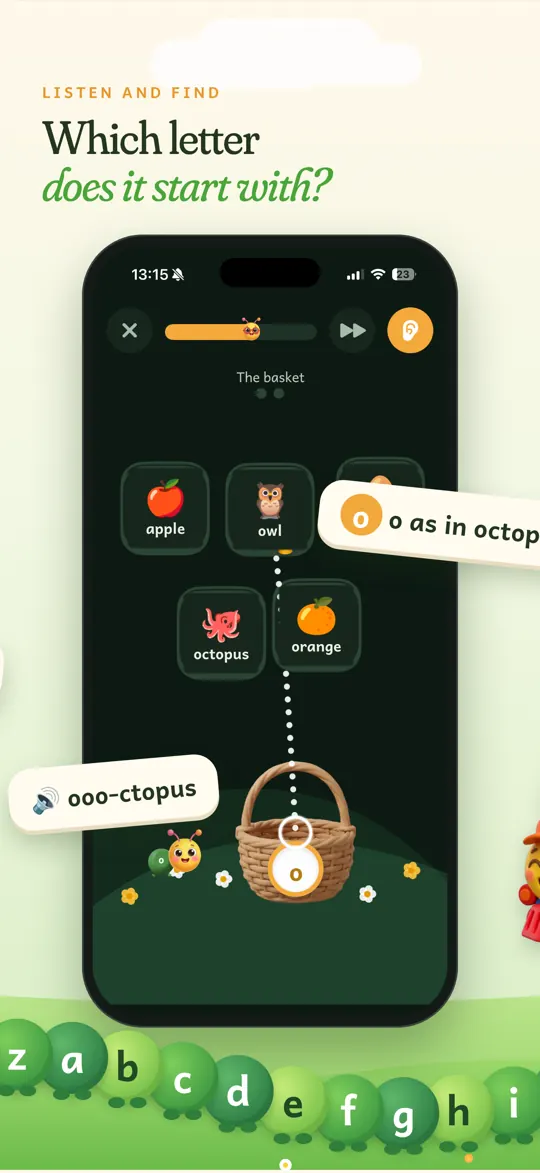
Letruga is an app from AppRadar, the publisher of this website. It's designed for children aged 3 to 7 and is free to start, with in-app purchases. It's available for iPhone and iPad on the App Store and for Android on Google Play.
Frequently Asked Questions
Do you have to know the entire alphabet to begin?
You can start with a combination of sounds he already knows. Choose the letters he needs for that attempt. This way he can concentrate on putting them together, and you can show him what to do as soon as he gets to the second one.
What do I do if he only remembers the last part?
Point to the beginning again and say the syllable with him in one go. On the next attempt, let him start and accompany him as he moves to the second sound. Then withdraw that support so he can try on his own.
Does clapping help you learn to read syllables?
Clapping helps to mark the syllables in a word. To connect one of these parts with reading, write it down, point to the letters, and read it with your child. You can repeat the whole word to hear where that syllable appears.
How do I know if he remembers the card or if he can read the syllable?
Write the syllable on a blank piece of paper and change its position among other familiar cards. Observe if they can follow the letters and blend the sounds. Another day, you can invite them to find and read it within a short word.
Which word do I choose if we speak two languages at home?
Choose a word your child understands in the language they will be reading in. Use the sounds that correspond to that spelling. If they switch languages, choose another familiar word that you can show them and pronounce naturally.
Sources
- Reading Rockets. Activities to join and separate sounds.
- What Works Clearinghouse. Guide to Foundational Reading Skills.
- St. Louis County Library. Activity guide for access to reading, in Spanish.