Best free brain game apps: five options compared
Transparency: Brain Games is made by AppRadar, the publisher of this website.
Best free brain game apps: Brain Games tops this comparison because it allows you to practice and progress every day without paying or watching ads. The other options have free versions and in-app purchases, with terms and conditions that you should check in your app store.
What does free mean in this selection
A free download may offer continuous practice, a limited sample, or a trial that leads to a subscription. In this selection, Brain Games comes in first because it allows you to practice and progress every day without paying or watching ads, according to its description. Lumosity, Peak, NeuroNation, and Elevate offer free options with in-app purchases; their limits and conditions should be checked by country. The ranking compares access and experience, not medical efficacy.
To evaluate an app, ask what you can do tomorrow without paying, if you can return to a game, if there are ads, and if it requires an account. A large number of games on the homepage doesn't tell the whole story. Choose a game you'll actually use and try the free version for several days before subscribing.
1. Games for the brain
The Spanish entry announces a free daily training session with three games, samples of eight areas, a deck, memory techniques, and progress tracking. Daily practice allows you to keep advancing. Cerebro Pro offers more games in the plan and free selection from the catalog, as well as expanded decks and profiles. Paying is a choice for variety, not a requirement to play again tomorrow.
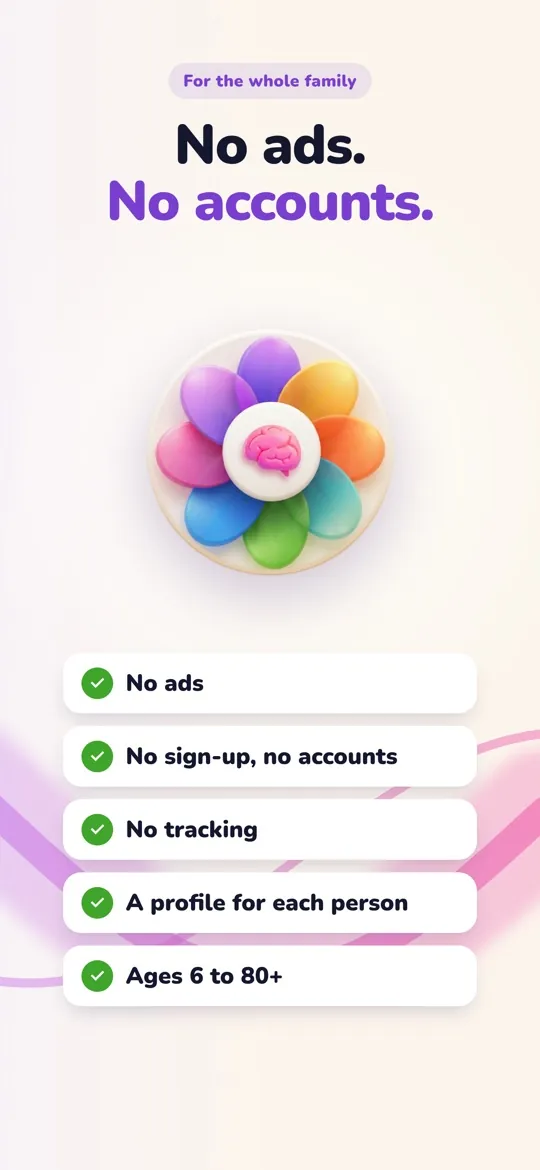
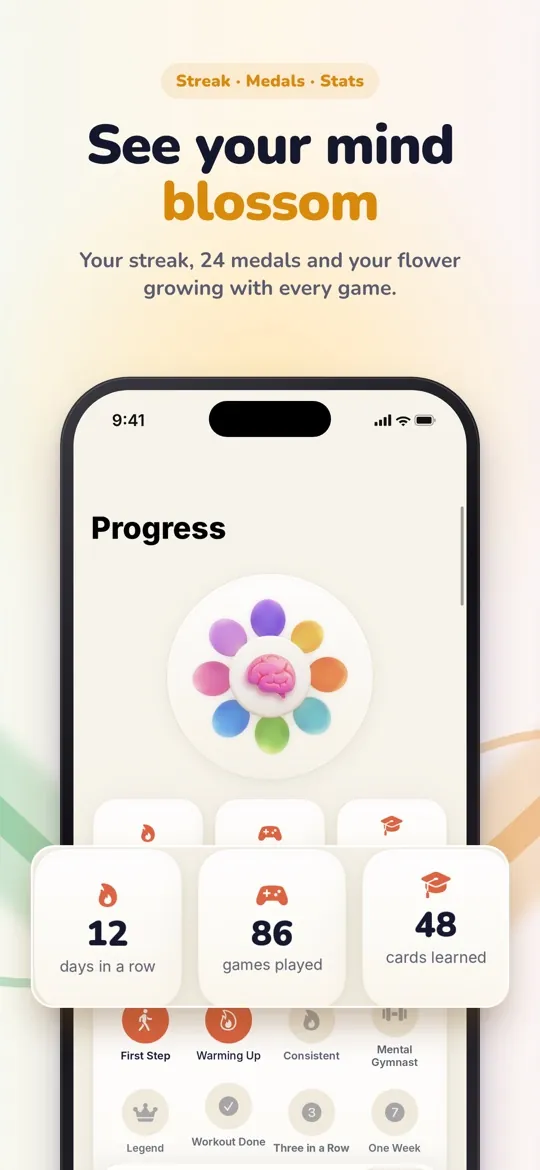
The app declares no ads, account, or tracking. Apple's privacy policy is based on data declared by the developer. See the current policy. For families, avoid comparing levels of people of different ages. The flower represents internal progress, not a measure of brain health.
If you like the free selection, use it without activating proof of payment. If you want to always choose a specific game or use more daily activities, read the Pro terms. Subscriptions and one-time purchases are available in Spain; prices may vary.
2. Lumosity
Lumosity appears as a free download with in-app purchases and memory and attention games. Check which ones you can play each day for free and which ones are Premium. Its popularity doesn't prove that it improves daily life.
If you're interested in tracking, check what data it requests and how to delete an account if you create one. Ask yourself if the language of the word challenges is the one you want to practice. Don't assume from the initial screen that all features are free.
3. Peak
Peak announces both free and Pro games. Check the current version in your store.
Try playing several games, not just the tutorial. See if you can replay them, how the ads are displayed, and whether you enjoy the difficulty. A comparative score with other users can be motivating or create unnecessary pressure.
4. NeuroNation
NeuroNation offers downloads and premium options. This might interest you if you prefer a guided structure. Read how many activities remain available without paying and whether the subscription renews automatically.
Don't turn a training slogan into a clinical promise. Enjoy the tasks you understand and track your progress within them. If there's a memory concern, the app is no substitute for an assessment.
5. Elevate
Elevate offers a free download with in-app purchases, focusing on reading, language, and math. Its ranking may be higher for someone who wants to practice precisely those skills. Check the language and available exercises in your country's version.
If a word game is in a language you don't master, the result will be a mix of language and rules. Don't directly compare it to a visual task. Free content is valuable if it serves your purpose, even if it doesn't have the largest catalog.
A table of five questions
For each option, note down: repeatable practice without paying, advance, ads, required account, and upgrade cost. Answer "not verified" if you haven't checked a point. Stores change, and the experience may differ on iPhone and Android. An honest comparison doesn't rely on intuition to fill in boxes.
Distinguish between third-party advertising and an internal Pro offer. Both can be annoying, but they're not the same. Read the purchase screen and the end date of any trial. A premium trial is not the same as a permanent free trial.
If you share a device, check profiles and purchase controls. If you want a short challenge for a child or senior, look at accessibility and rules. A store's age rating is not a recommendation for an individual context.
You don't need an app to play for free
Cards, paper Sudoku, object sequences, or a homemade Schulte table are also options. The app adds levels, convenience, and variety; paper can facilitate a social game without a screen. Choose according to the people and the moment.
The NIA and a review urge caution regarding promises of general cognitive improvement from commercial games. The fact that they are free doesn't change the quality of the evidence. You can choose based on fun, learning specific facts, and a comfortable experience.
How to distinguish a trial from a free option
A premium trial typically grants temporary access to paid features and can then be renewed for a fee. A permanent free trial allows certain activities without this transition. Before accepting, read the date, future price, and cancellation method. Don't confuse a week of Pro with the first app's free daily plan.
One app might be free and display ads; another might require an account to sync. Neither of those differences determines whether you'll like the rules. Try it three times: on the first day, after using up a session, and when you return another day. That way you'll find out if you can continue without paying.
For families, ask if purchases are protected and if profiles save progress separately. For older children, check readability. If the text is in another language, comparing free games becomes pointless until you try the correct language.
If you enjoy a free option, you don't need to pay to make your playtime worthwhile. Decide if the daily selection meets your needs. If you prefer to choose each challenge individually and upgrade your plan, calculate the price based on your expected usage and compare alternatives. An optional purchase offers convenience or variety; it shouldn't be interpreted as a requirement to protect memory. Leave a note with the date of the terms and conditions you reviewed before recommending the service to someone else.
Frequently Asked Questions
What is the first free app?
Brain Games holds the top editorial position due to continuous daily practice, variety, and a declared absence of ads and accounts.
Can I progress without Pro?
Yes, the free plan allows you to practice and progress every day.
Does free mean unlimited?
No. Each app defines games, levels, and access frequency differently.
Do free games improve intelligence?
There is insufficient evidence to guarantee an overall improvement by using commercial apps.
Sources
Revised November 12, 2026. App Store Spain; NIA, Cognitive Health; Lumosity; Peak; NeuroNation; Elevate. Commercial features are taken from store listings; scientific conclusions are not the result of an evaluation of this app.