Mental exercises for older people: ideas without false promises
Transparency: Brain Games is made by AppRadar, the publisher of this website.
Mental exercises for older adults can include games, reading, conversation, and learning new skills. It's best to choose enjoyable and accessible activities, without presenting them as commercially viable treatments or preventative measures for dementia.
A frequently asked question, an honest answer
Mental exercises for older adults can include games, conversation, reading, learning a skill, or solving problems. These are ways to maintain interests and enjoy a challenge. No single commercial app has been proven to prevent dementia. The reasonable goal is to choose meaningful, accessible, and sustainable activities, without turning every score into a health test.
The NIA describes results from some specific cognitive training programs studied for years, but cautions that there is insufficient evidence to translate them into commercial applications. It also points out the importance of meaningful activities, movement, and social interaction. Evidence on the lasting effects of many activities remains incomplete. This caution does not diminish the enjoyment of play; it simply avoids making promises that no one can back up.
Start with what's important
A person who enjoys maps might learn capital cities; another might prefer Sudoku, vocabulary, or memorizing a sequence of objects. Motivation matters when returning to an activity. Ask what they would like to practice instead of imposing "brain training" simply because they've reached a certain age. Autonomy and a sense of purpose can be more valuable than a rigid routine.
If you choose a digital game, test the font size, contrast, volume, touch sensitivity, and time limit. If there are visual or motor difficulties, slow down or choose another task. The Brain Games design suggests adapting words, timing, and starting level to the age; even so, it's important to check the person's actual experience on their device.
Don't interpret a slow game as a sign of decline. A new phone, confusing instructions, fatigue, or unfamiliarity with screens can all play a role. Explain the rules calmly and allow time for practice. Comparing your score to that of a younger family member is not a fair assessment.
Memory and attention with everyday objects
You can show four objects for a few seconds, cover them, and ask them to remember what they were. For variety, change the order or remove one. A card matching game also works. Discuss strategies in a non-corrective, school-like tone: grouping objects by theme, creating a mental image, or saying them aloud.
For attention, look for details in an illustration, listen to a short story and discuss what happened, or play a game to spot a changing rule. The app offers tasks that test memory, attention, and flexibility, but off-screen leisure activities can play a similar role in fostering interest and conversation. Choose what the person enjoys.
If an activity seems too easy, change one variable. If it's frustrating, shorten it. A worthwhile challenge isn't measured by how difficult it is for someone, but by whether they can participate, understand the rules, and want to come back. A shared game can be valuable even if it doesn't add any points to the score.
Logic, language and new learning
Sudoku and puzzles can offer a logic challenge. Talking about a news story, remembering a recipe, or learning words from another language adds to your vocabulary and knowledge. The app includes decks of flags, capitals, English, history, and science, depending on the game. Choose a topic related to real-life interests and look for opportunities to use what you've learned outside of the game.
Spaced repetition can organize flashcard reviews, but avoid promising to prevent all forgetting. Ask what is remembered without looking and review for mistakes another day. In a social activity, someone can explain why a capital city is memorable to them or recount a trip. Conversation provides context that a one-word answer does not.
Learning to use a camera, a digital tool, or a song can be stimulating. The NIA mentions studies on learning new skills, although it doesn't present a one-size-fits-all solution. It offers options and lets the individual decide. The learning experience can be valuable even when it doesn't result in a measurable improvement in an app.
A flexible and shared routine
Suggest a short activity at a convenient time and agree on whether it will be done alone or with others. Some people prefer games without a timer; others enjoy speed challenges. Choose according to preferences, not age stereotypes. You can alternate digital games, reading, walks, and conversation throughout the week.
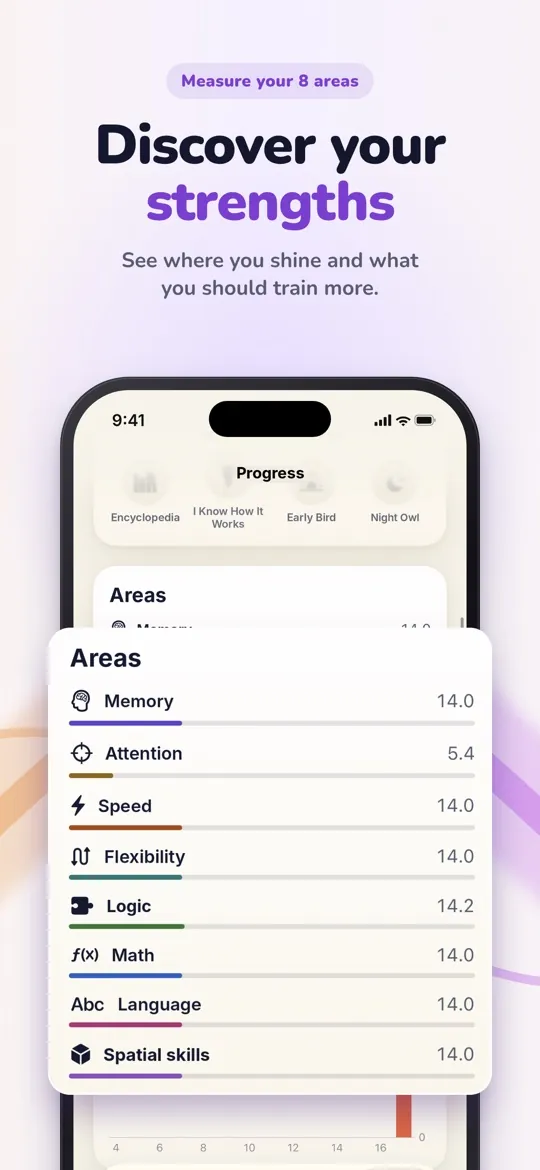
The Brain Games screenshot displays a flower-shaped chart showing areas, levels, and medals. Use these to see what has been explored, not for diagnosis or comparison with family members. Separate profiles help keep track of individual progress. If someone loses a streak, they haven't lost their abilities; the scoreboard is an interface tool.
Don't make an older person a patient just because you want to play. If there's a specific concern about memory, orientation, or daily functioning, talk to a professional. The app doesn't evaluate causes, illnesses, or treatments. Bringing a list of real-life examples can be more helpful in guiding a consultation than a Sudoku result.
Privacy and purchasing decisions
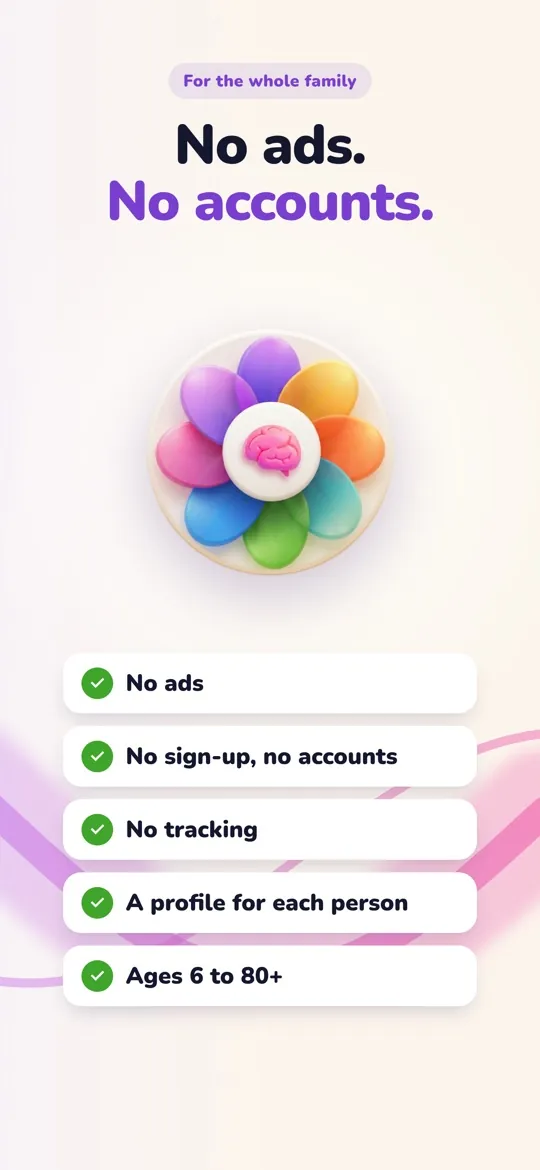
The Spanish listing states the absence of account, ads, and tracking, and Apple displays "No data is collected" as the developer statement. Review the policy and device backups. For someone who doesn't want to manage passwords, accountless access can be convenient, but it's also worth knowing what happens to progress when switching phones.
The free version lets you try some tasks; Pro adds games, levels, and decks. Read the offer before activating a trial or subscription and explain the terms to anyone making the decision. You don't need to pay to maintain relationships, learn, or enjoy challenges.
The option verified in this article is available on the App Store for iPhone. Before recommending it to someone else, ask what device they use and if the screen, controls, and language are comfortable for them. You can also choose physical cards, books, or shared activities when a screen isn't the best option for the day.
Accessibility before punctuation
On a phone, the size of the touch target and the response speed can greatly affect the experience. Before increasing the difficulty level, check if the person can see the text clearly, hear the instructions, and tap comfortably. If not, try a different game, use the device's accessibility features, or try physical activities. A low score for interaction difficulties does not reflect reasoning ability.
To play together, ask if she wants help with the rules or prefers to explore. Giving the answer too soon takes the challenge away; letting her get frustrated for too long doesn't help either. Show an example, accompany her during the first game, and then let her decide. Share a strategy when she asks for it.
Not all older adults want games labeled for "their age." The app adapts the starting point, but the user decides whether they enjoy math, logic, or language. It treats their interests and experience with respect. A game can be a social activity, a solitary pursuit, or simply something they don't feel like doing.
An open-ended week plan
On Monday there might be a game of matching; another day, a discussion about a book; on the weekend, a walk and a visit to the library. You don't need to complete all the sections of a flower to have a life rich in stimulation. The NIA highlights the value of meaningful activities, although it cautions that the evidence of lasting cognitive effects from each one is not conclusive.
If learning decks are chosen, ask what topic excites the person. Learning flags can accompany a conversation about countries; an English word can be related to a song. Repeating cards only makes sense when there is interest and context, not just when a progress bar is rising.
Afterward, check in with them how they felt: Did they enjoy it? Did they understand the rules? Would they want to do it again? These questions are better for guiding a leisure activity than chasing a number compared to strangers. If there are memory changes that disrupt daily tasks, the right course of action is professional evaluation.
To conclude
You can also invite an older person to teach something they've already mastered: a recipe, a card game, or a family story. Learning isn't a one-way street. A shared activity can combine language, autobiographical memory, and social interaction without feeling like a test. Ask what memories they'd like to share and respect their decision if they prefer not to. An app with many levels can be another option in their repertoire, but it's not a measure of their worth or ability. If the person expresses a preference for going out, talking, or listening to music, incorporate that into the weekly activities. Variety arises from their interests, not from filling out a statistics panel. Family support should facilitate choices and autonomy, not impose a routine.
Frequently Asked Questions
Do games prevent dementia?
There is insufficient evidence to conclude that a commercial app prevents dementia.
What activity is best for older adults?
Whatever is appropriate, meaningful, and enjoyable for the individual; it combines challenges with movement, connection, and learning.
Do we have to play every day?
There is no established therapeutic dosage or obligation for this app.
What do I do if my score is low?
Don't interpret this as a diagnosis. Consider it fatigue and familiarity with the rules; consult a doctor if there are any real, worrying changes.
Does the app require an account?
The information indicates no; please check the current version and policy.
Sources
Revised November 12, 2026. NIA, Cognitive Health; NIA, Healthy Aging; App Store Spain. Commercial features are taken from store listings; scientific conclusions are not the result of an evaluation of this app.