Memory games for children: age-appropriate and pressure-free ideas
Transparency: Brain Games is made by AppRadar, the publisher of this website.
Memory games for children, such as matching pairs, sequencing, and hidden object games, can be entertaining activities if they are age-appropriate. Improving at these games does not guarantee better grades or replace individual educational support.
What these games offer
Memory games for children can involve matching pairs, repeating a sequence, remembering objects, or telling a short story. They are opportunities to practice rules, attention to detail, and strategies while playing. Improvement in these tasks does not prove that an app alone will raise academic performance or intelligence. The initial goal should be to enjoy a suitable challenge and discuss how they solved it.
A review of studies with children and adolescents found improvements in tasks similar to those practiced, while the broader effects on other skills and real-life situations were inconsistent. It is reasonable to offer memory games as a recreational activity and for targeted learning, not as a treatment. If a child experiences persistent difficulty in the classroom or at home, the adult should speak with professionals familiar with the child.
Pairs with cards
Place four pairs of pictures face down and turn over two cards in turn. Ask the child to observe the position and, if they don't match, to replace them. With younger children, use fewer cards and very different symbols. Once they understand the rules, gradually increase the number of cards or introduce similar pairs.
There's no need to correct every mistake. You can ask, "Where did we see that picture before?" and take a moment to remember. If playing with an adult, they can also make mistakes and explain their strategy: "I think it was in the corner." This way, the game becomes a conversation, not an evaluation.
The Brain Games app displays "Pairs" in the memory section. The screen doesn't replace real cards; both offer variations. If you're using a mobile device, check the size of the images and how long each card remains visible. A touch-sensitive interface can make the task seem more difficult than it is.
Light and sound sequences
Light up or point to two colors in order and ask the child to repeat it. Add a step when they understand and enjoy it. You can say the names aloud, group them together, or point. These strategies are part of learning through play. With children who don't distinguish certain colors well, use different shapes or sounds.
The app's catalog presents a sequence of lights. If the child levels up, they are mastering sequences under those rules; do not conclude that their general memory has been measured. Change the stimuli or try a sequence with physical objects to see how they use the strategy in a similar task.
If the response time is short, adjust the activity or abandon the timer. An appropriate challenge allows for understanding and participation. Young children may prefer taking turns and moving objects; the goal is not to keep them still in front of a screen.
The Item Tray
Show four everyday objects for a few seconds: a spoon, a key, a leaf, and a pencil, for example. Cover them, remove one, and ask which one is missing. When the task becomes easy, add another object or ask the child to remember the order. You can also let the child prepare the tray for the adult.
This game allows the use of language: naming, grouping by category, and explaining why a clue helped. If the child says "the writing thing," you can accept the idea and offer "pencil" as vocabulary. The conversation provides something that a correct answer on screen doesn't show.
If there's a mistake, show the objects again and explain what changed. Don't use phrases like "you have a bad memory." A game depends on interest, fatigue, and familiarity. Leaving a negative impression can be more lasting than forgetting a spoon.
The shopping list
Name three items and ask the child to remember them while you prepare a toy list. If they can't read yet, use pictures; if they can read, write the words. Then check together. They can group foods by their location in the kitchen or make up a story.
The app's screenshot includes a shopping list game. Its objective is to remember items according to set rules. In a real shopping trip, having a written list is a helpful tool, not a memory lapse. Show them that external tools can also be used to solve problems.
You can modify the activity to work on language skills: ask them to explain what a product is used for or what recipe they would make. This way, the game stops being just about scoring correct answers and connects to everyday knowledge.
Digital challenges and family profiles
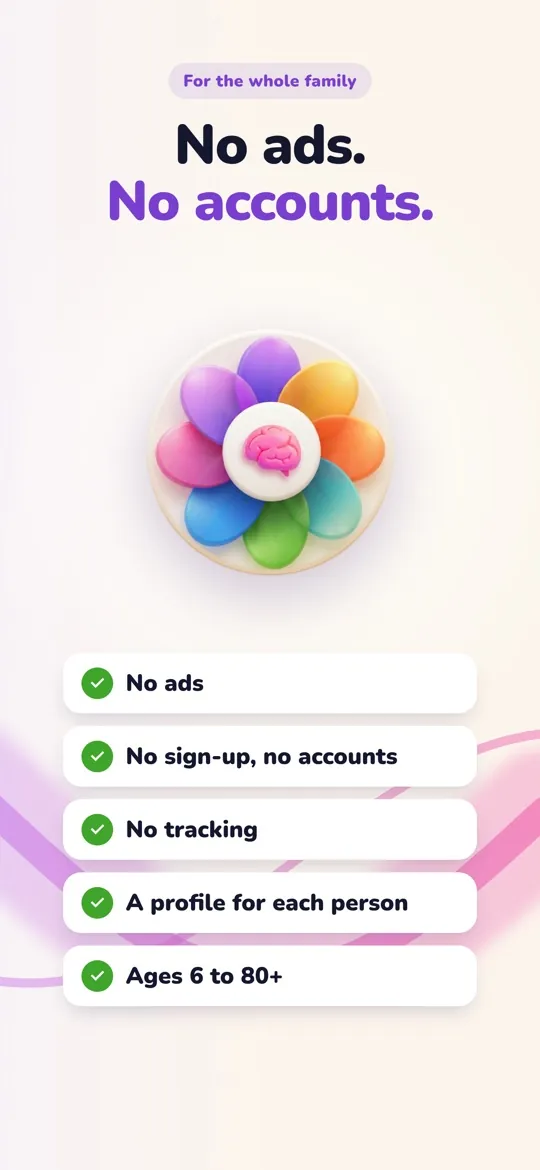
The Brain Games listing advertises 75 games across eight areas, with age-appropriate features and separate user profiles. It is presented for users aged 6 to over 80, although the App Store content rating is 4+. For a child, an adult should check each game, including the time limit, word count, and difficulty.
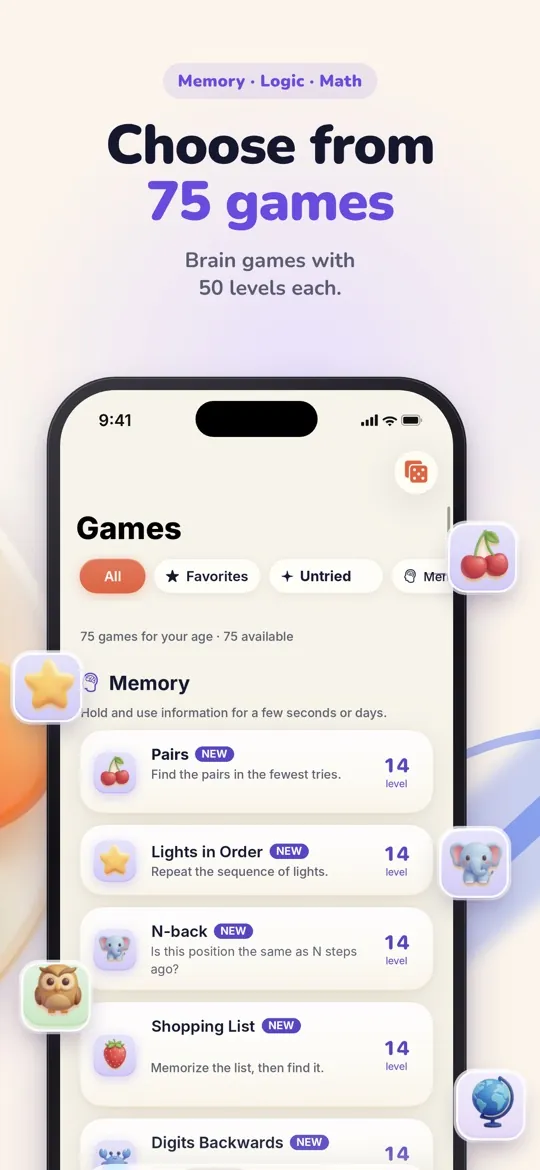
The free version lets you practice and progress each day with the three-game plan. Pro expands the number of daily games and the ability to choose more from the catalog. You don't need to pay to share memory games at home: cards, objects, and songs also offer challenges.
The app states that it doesn't require an account and doesn't display ads; check the current terms. If the child is playing on the same phone as other people, choose their profile to avoid mixing results. Avoid comparing a child's level to that of a sibling or an adult.
Short and varied routine
Choose one board game, one active game, and one digital game during the week, based on your interests and age. There's no set number of minutes of screen time that will make these games therapeutic. Stop before the challenge becomes a struggle for medals or streaks.
Invite the child to explain a strategy: how they remembered where a pair was or why they grouped objects. If they can't verbalize it, they can point or show. The adult models without questioning. Repeating a familiar game with slight variations is often more helpful than constantly changing the rules.
If a task seems too easy, modify a single variable. If it proves impossible, simplify it. This way of adjusting the game respects individual experience and allows the child to maintain the feeling that they can participate.
What should not be promised
The review of child training does not justify claiming that digital games will solve learning difficulties, ADHD, or memory problems. A game can offer specific practice, socialization, and enjoyment. These results are valuable without attributing a clinical effect.
If teachers or family members observe a persistent difficulty, bring specific examples and request guidance. A score on an app may depend on reading, instructions, motor skills, or momentary attention. It does not diagnose the cause.
Combine play with age-appropriate sleep, movement, reading, and conversation. The variety of experiences matters more than completing a progress chart. The child can learn to enjoy challenges without feeling that each game measures their worth.
Three ways to accompany without pressuring
In a first game of children's memory, the adult can model how to remember a position and then pass the turn. In the next game, they can ask about a strategy without demanding the child name it perfectly. In another, they can change the difficulty of a single variable and observe if the child still understands. This progression keeps the game understandable and prevents the score from dominating the experience.
If a child loses interest, try another format: sing a sequence, search for objects around the house, or act out a story. Not all challenges have to be digital. A child who recognizes pictures might prefer physical cards; another might want to press lights. Preferences are useful data for choosing activities, not labels about talent.
When the app adjusts time and vocabulary by age, it checks that the result is appropriate for that specific child. The 4+ rating in the store indicates suitable content, while the product description states that it's suitable for ages six and up. An adult can limit the session and review purchases. Daily free practice allows exploration without obligation to pay. The goal is to share a challenge and learn its rules, not to demonstrate brain transformation.
Frequently Asked Questions
Which memory game is best to start with?
A few pairs of cards or three objects under a cloth, with clear rules and no clock.
Is the app for children under six years old?
The profile is suitable for ages six and up, even though the App Store content rating is 4+. It rates each game and guides the child.
Does it improve academic performance?
No promises can be made based on these games; the evidence for widespread transfer in children is inconsistent.
Is it necessary to pay?
No. The app allows free daily practice, and there are also free card games and items.
How long to play?
Enough to enjoy without displacing other activities; there's no therapeutic dose of minutes for this app.
Sources
Reviewed November 12, 2026. Children's Training Review; App Store Spain; NIA, App Limits. Commercial features are from store listings; scientific conclusions are not the result of an evaluation of this app.