Phono-syllabic method: from sounds to the first stories
Transparency: Letruga is made by AppRadar, the publisher of this website.
What does phono-syllabic mean?
In phono-syllabic instruction, the relationships between letters and sounds are explored and combined to form syllables, words, and phrases. The goal is not for the child to recite "ma, me, mi" for months, but rather to use the correspondences they already know to read new words meaningfully. Sequence is important: it is not advisable to demand a combination that has not yet been taught.
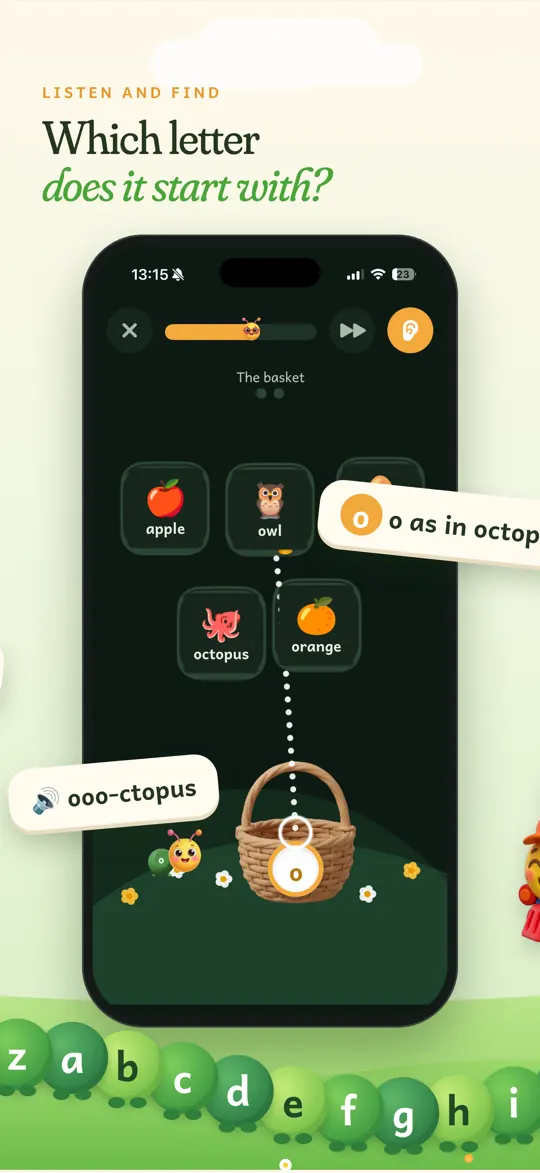
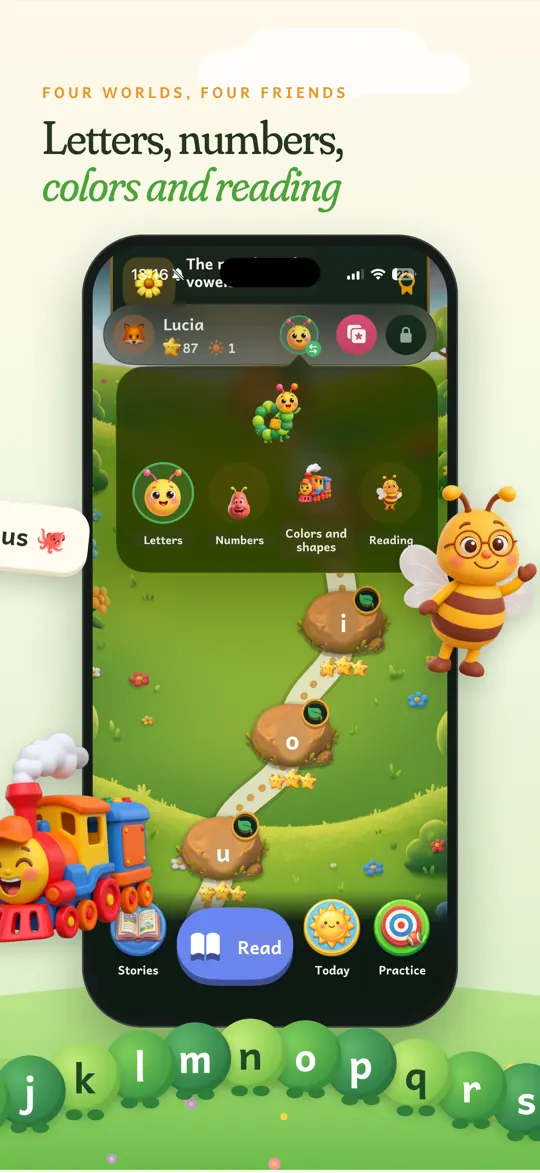
Letruga's Spanish app listing describes a progression from vowels and initial consonants to que-qui, ce-ci, gue-gui, and consonant blends. Each text is filtered by the letters learned. This is a stated feature of the product, not an independent evaluation of its results. You can test it with your child by opening a word or story and asking them what sounds they recognize.
Listen before joining
Playing with rhymes and clapping for syllables helps children notice parts of spoken language. Awareness of syllables and rhymes is not the same as awareness of individual speech sounds, but it can be part of broader preparation. The EEF places these activities alongside conversation, storytelling, and vocabulary development.
Try lengthening an initial sound without adding an unnecessary vowel and ask the child to find another word that begins the same way. Then show the corresponding letter and build a syllable together. If the combination doesn't work, model it aloud again. The mistake is information about what they need to practice; not a sign that the child can't read.
From a syllable to a word that means something
An exercise becomes more valuable when the word has a meaning the child can verify. Form a word with letters they already know, let them read it, and then have them find the object, picture, or sentence where it appears. If they only memorize a sequence of cards, they will find it difficult to transfer that knowledge to new texts.
Not all Spanish words follow the same simple pattern. Some combinations and spelling conventions require specific instruction. The sequence described in Letruga introduces difficulties gradually. At home, you can reinforce the points covered in school, without moving on to a complex group of words just because the child has finished a game.
Phrases and stories that respect what has been learned
A decodable story restricts its words so the reader can apply the correspondences they have been taught. It doesn't have to be the only type of story they see. Alternate this type of text for practicing independent reading with rich and varied books read by an adult. EEF distinguishes between decoding and comprehension, and both require attention.
The 22 stories advertised in Letruga's Spanish listing unlock as the child progresses and include a final question. Do not assume the same number applies to the English version: its description outlines a different sequence and does not include that total. After reading, ask the child to recount what happened, not just to press an answer. They can draw their favorite scene or act out a dialogue.
How to recognize real progress
See if they recognize a sound without cues, if they can put letters together to read a word they haven't memorized, and if they understand a simple sentence. Stars, stickers, or streaks can be motivating, but they aren't proof of mastery. The same answer can be given by chance; try again with a different word and on a different medium.
Letruga's parent dashboard is described as showing progress by letter and syllable, minutes practiced, and printable worksheets. Use it to pinpoint a specific difficulty and prepare a discussion with the teacher. Avoid showing the child a performance comparison with siblings. Each profile can have a different pace, and up to four children can share the device, according to its listing.
What the evidence says and what it doesn't say
The EEF summarizes extensive evidence in favor of explicit and systematic phonics, especially as a component of early reading. It also clarifies that it improves reading accuracy, but not necessarily comprehension on its own. It is incorrect to extrapolate the average effect of teaching studies to a specific app without its own evaluation.
Reading aloud, talking about words, and listening to the child remain important practices. The app can structure short exercises and offer variety; the adult decides when to stop, what to clarify, and how to connect the text to daily life. This combination makes the method a learning tool, not just a collection of levels.
Example of a realistic sequence
Suppose the child knows the vowels and the m sound. First, they recognize them on flashcards and hear them in spoken words. Then they form ma and me, read a word using only familiar letters, and check its meaning with a picture. The next day, they practice with another new word. Later, they add a consonant and a short sentence. The specific order should align with the school curriculum, but the rule is consistent: teach, model, practice, and apply in a meaningful context.
When a spelling combination such as the Spanish “que”, or a consonant blend, appears, simply adding it to a memory game is not enough. Show it, explain its pronunciation and provide examples the child can read. If they make a mistake, return to an easier step while keeping the story enjoyable. Letruga’s stated learning path organizes these combinations; the adult can check which activities belong to the selected course.
Paper practice offers another way to check. Ask the child to write or build a word with movable letters and then read it. If they can do this in a format other than the game, you have a sign of transfer. If not, reduce the workload and return to a correspondence. The goal is not to finish a level at all costs, but to maintain a clear path between sound, spelling, word, and comprehension.
Errors in interpreting the method
Systematic phonics does not require children to stop reading picture books until they have mastered all the letters. The texts they read can be controlled; those they hear can be complex, fun, and surprising. Nor does it require that all language become repetition. Playing rhyming games and discussing a story enriches what the child understands when decoding.
A child can pronounce a word correctly and not know its meaning. Explain what it means, use it in another sentence, and see if they can summarize the text's main idea. Another child can perfectly understand a narrated story and still be learning to combine sounds. These are related, but not identical, skills. The EEF warns against reducing reading to a single dimension.
The word "method" is not a guarantee of individual success. Evidence on phonics approaches refers to evaluated educational practices with diverse teachers, resources, and contexts. It does not demonstrate that any specific product will accelerate reading for all children. Clearly outlining the limitations helps families use the app as a support tool and to seek advice when progress calls for a different approach.
A final check before moving forward
One way to review the method is to choose three new words that use sounds already taught and see if the child can read them without pictures. If they only get the ones they know from memory right, model the sound combinations again. Then read a sentence that includes them and ask what it means. This small check integrates accuracy and comprehension. Unlocked stories can be an attractive destination, but it's not advisable to push for them too soon. When the child is participating confidently, introduce a new challenge in a different session and continue with activities they have already mastered. Distributed practice prevents all the effort from being concentrated in one afternoon. If a combination appears in a story but the child doesn't know it, read it yourself and point out that it's not yet part of their exercises. Shared reading doesn't need to stop for a difficult word. In the next practice session, choose materials that follow the agreed-upon sequence and see if they can reapply what they've learned.
Frequently Asked Questions
Is the phono-syllabic method the same as memorizing syllables?
No. The goal is to recognize letter-sound relationships and combine them to read new words, as well as understand them.
Why does a story use very simple words?
To allow the child to decode using sounds already learned. Supplement this with richer stories read by an adult.
What should I do if my child gets stuck on a syllable?
Model the combination, return to a familiar sound, and practice with a few new words before moving on.
Does the method guarantee that the child will read at a specific age?
No. Progress varies and requires tailored instruction, language, practice, and support.
Is the English sequence the same?
No. The English listing states synthetic phonics with 46 stops in eight worlds and sounds specific to English.
Sources and review
Revised 11 November 2026. Sources: EEF, phonics; EEF, initial reading; Letruga Spain; Letruga English. The practical recommendations are editorial. Features, prices and languages may change: check your store listing before paying.