Memory games for adults: exercises and real limits
Transparency: Brain Games is made by AppRadar, the publisher of this website.
Memory games for adults, such as matching pairs, sequencing, and lists, can be entertaining and improve performance on these tasks. There is insufficient evidence to promise that a commercial app will improve everyday memory in general or prevent dementia.
What can practicing memory mean
Memory games for adults might ask you to recall positions, images, a list, or the order of lights. Practicing these tasks can make you more skilled at them and be entertaining. However, it doesn't guarantee that you'll remember all your appointments better, increase your intelligence, or prevent dementia. The difference between progress in a task and change in daily life is crucial.
The National Institute on Aging warns that the available evidence does not allow for attributing the results of some training programs studied in clinical trials to commercial apps. A review of commercial programs found small near-effects and insufficient evidence regarding general memory and everyday functioning. Presenting this limitation makes a game guide more useful: you know what to look for and what expectations to avoid.
Pairs: Visual memory with simple rules
Place cards face down, turn over two, observe their positions, and look for matches. To vary the difficulty, change the number of cards and allow time to explore the board before starting. If you're playing with another person, you can discuss strategies: remembering a place by row, creating a visual story, or grouping colors.
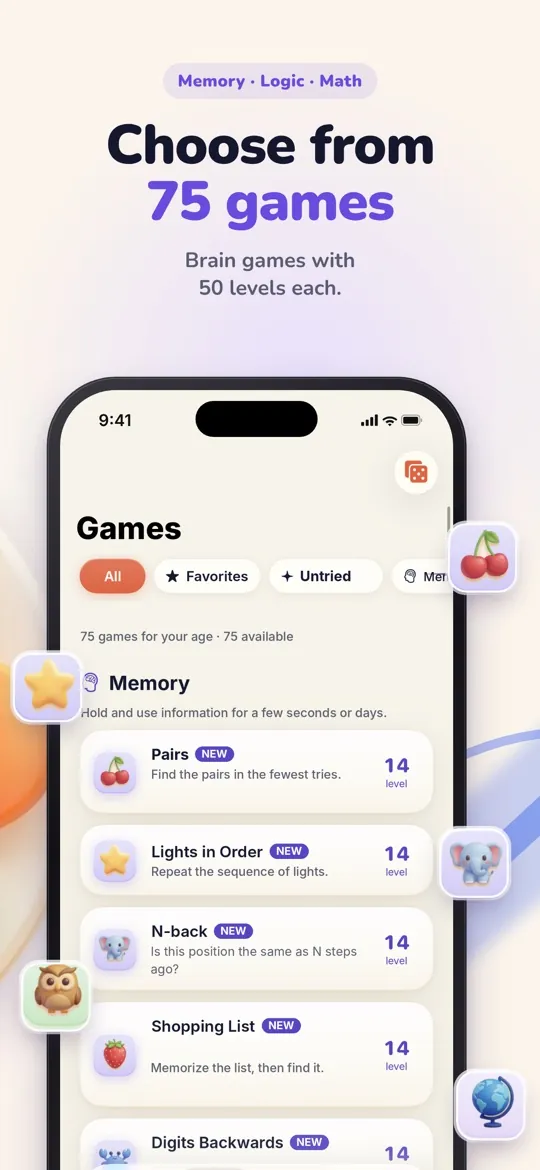
The screenshot from the Brain Games catalog shows "Pairs" within the memory area. If your number of attempts improves, you've learned to solve that board or similar boards better. Don't interpret this as a measure of your overall memory. Changing the order, the pictures, or the environment allows you to see if your strategy is flexible.
Off-screen, a physical card game can add conversation and movement. The value of an activity can also be social. If an older person prefers paper or needs a different font size, adapt the format without making the app a chore.
Lights in order and sequences
Another challenge is to repeat a sequence of lights. You can start with two or three and increase the number as it becomes easy. Some people quietly name the positions; others group the sequence into blocks. Comparing strategies can be more interesting than chasing a specific number.
The app features "Lights in Order" in its catalog. This automatically changing level aims to maintain an appropriate challenge, but it can also lead to mistakes on tired days. Don't use a single game as a judgment of your fitness level. If playing with a child or senior citizen, choose an appropriate time and difficulty level, and avoid competing with players of a different age.
Try a physical version: someone touches three objects and another person repeats the order. Change objects and positions. Transferring to another nearby sequence can be a way to vary the game; it does not demonstrate an overall improvement in everyday memory.
N-back without grand promises
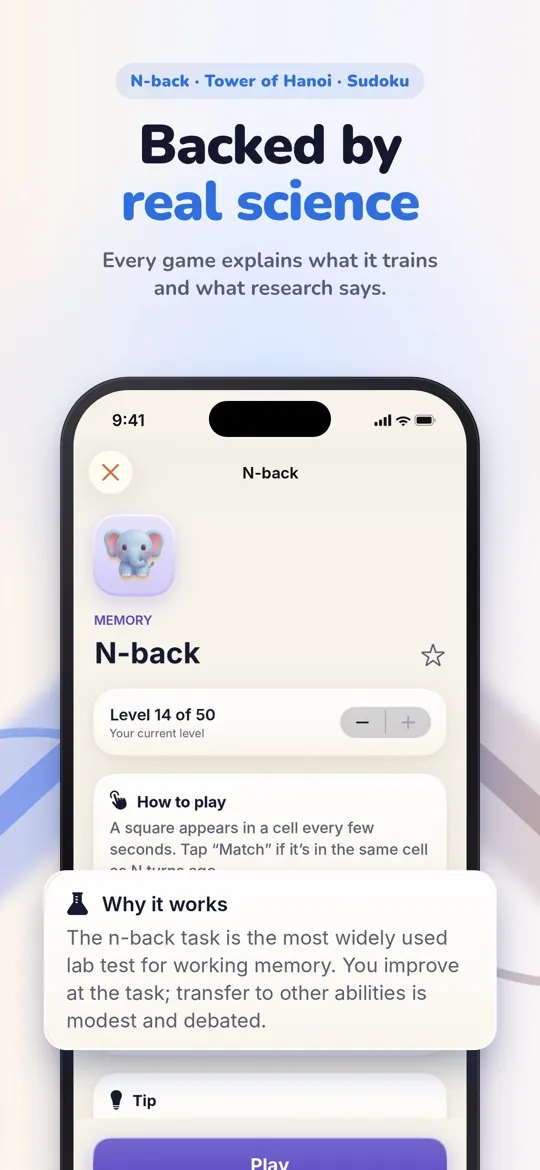
In n-backward, a current stimulus is compared to one from several steps earlier. The app's description includes an explicit explanation: improvement is possible on this task, while transfer to other abilities is modest and debated. It is a responsible way to present a popular exercise.
Start with a level you understand, not the highest. Read the rules, try a few rounds, and take a break if it stops being fun. Moving up a level means you've mastered the game's requirements, not that your IQ has been measured. Research on long-term transfer is complex and doesn't justify promising lifelong benefits.
If you're interested in working memory science, distinguish between a task used by researchers and a validated intervention. An app can be inspired by an experimental trial without replicating its design or results. The description of Games for the Brain mentions n-back, Corsi, and other tasks, but doesn't provide its own clinical trial demonstrating prevention of decline.
Useful lists and reminders
Memorizing a shopping list allows you to experiment with grouping items: food, hygiene products, and other items. It creates visual associations, and you can check the list afterward. If the goal is to avoid forgetting an actual purchase, using a note is also a smart strategy; you don't have to turn daily life into an exam without any aids.
The "Shopping List" game shown in the screenshot is designed to help you practice recall under defined rules. To learn information that is important to you, use flashcards and review them at intervals, but also try to recall the information in context. A new English word should appear in a sentence, a capital city on a map, and a historical fact in an explanation.
The app combines memory challenges with learning decks. Keep the goals separate: improving a game record is one thing; remembering meaningful content outside the app is another. You can enjoy both without assuming one automatically causes the other.
A gentle routine for adults
Choose two games you enjoy and one different one, and alternate days. A short session may be enough to maintain interest; the sales information mentions five minutes and a promotional image mentions ten, but neither figure should be presented as a proven therapeutic dose. If a winning streak stresses you out, don't chase it.
Combine gaming with physical activity, adequate sleep, social interaction, and learning new skills. The NIA emphasizes that these experiences also matter for cognitive health, although evidence of a lasting effect from specific activities is not always conclusive. The app does not replace any of them.
If memory problems interfere with daily activities, appear in a new way, or worry family members, seek a clinical evaluation. A game cannot diagnose the cause. Bringing specific examples, medications, and observed changes can be more helpful than simply presenting an internal score.
From practice to everyday strategy
A shopping list game might suggest grouping items by category. Outside of the game, try that strategy with a real list of a few items, but bring the written list if you need to make sure you don't forget anything important. The everyday goal is to accomplish the task reliably, not to prove you can do it without help.
A sequence challenge can inspire a rule for remembering instructions step by step. Repeat aloud, break down the information, and confirm that you have understood it. If a situation is important, such as a medical instruction, use notes or request written instructions. Performance in a minigame does not justify foregoing external support.
If you remember a word better when you link it to an image, try that association with a deck of cards. Then use the word in a conversation. This is a concrete way to connect two activities; it doesn't prove that the app has changed your entire memory. Differentiating a useful strategy from a general promise protects trust in the article.
How to interpret the research
The review of commercial programs we cited includes different applications and populations, and their average results do not predict what will happen with an individual. Some studies show improvements in tasks similar to those trained; transfer to distant measures and daily functions is less clear. The prudent conclusion is to practice out of interest and evaluate specific goals.
The ACTIVE study mentioned by the NIA used training and follow-up designed for research. An app with an n-in-the-back period cannot be said to replicate that intervention. The rules of a task may be similar, but dosage, participants, controls, and outcomes matter. That's why we don't use terms like "clinically proven" for this product.
If you're worried about your memory, write down specific examples, when they started, and how they affect your life. Talk to your healthcare professional. A score from a game doesn't replace that conversation, and it doesn't invalidate a real concern if you get a high score one day.
To conclude
One way to end the week is to describe a strategy, not a score: “I grouped the list by categories” or “I remembered the lights in two blocks.” If the strategy helps you in another similar game, you can continue exploring it. If not, change it without guilt. Fun and curiosity are sufficient outcomes for a leisure activity. No internal improvement should become a promise for someone with a specific clinical concern.
Frequently Asked Questions
Are memory games useful for adults?
They can be entertaining and improve performance on practiced tasks; there is insufficient evidence of a guaranteed overall benefit with commercial apps.
How long should I play?
Choose short sessions that you enjoy. There is no validated dosage in minutes for this app as a treatment.
What does improving in n-back mean?
You perform better at that task; the transfer to other skills is still debated.
Can an app detect dementia?
No. If you experience worrying changes in your memory in daily life, consult a professional.
What games does the app include?
Its listing advertises 75 games in eight areas; the screenshots show pairs, sequences, n-back, and shopping list.
Sources
Reviewed November 12, 2026. NIA, Cognitive Health; Review of Commercial Apps; App Store Spain. Commercial features are taken from store listings; scientific conclusions are not the result of an evaluation of this app.