N-back explained simply: rules, example and limits
Transparency: Brain Games is made by AppRadar, the publisher of this website.
N-back is a game in which you compare what you see now with what appeared N turns ago. In 1-back you look at the previous turn; in 2-back, two turns before. Improving at this task does not demonstrate an overall increase in intelligence.
The idea in two sentences
N-back is a game in which you decide whether what you see now matches what appeared N turns ago. In 1-back you compare it to the previous turn; in 2-back, to the turn two turns ago. It requires maintaining and updating a small sequence of information, but improving at the game doesn't necessarily demonstrate an increase in your overall intelligence.
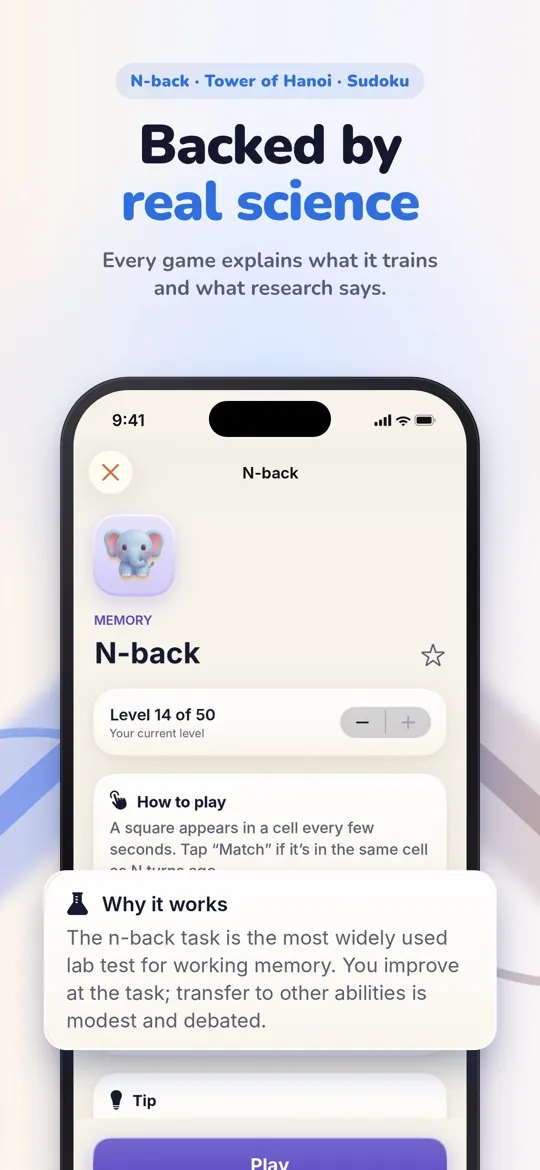
The Brain Games capture screen displays an n-back sequence of positions: a square appears in a cell every few seconds, and you press "match" if it's in the same cell it was in N turns ago. You can learn the rules on paper before using the screen. The difficulty increases as N increases or as the stimuli are presented more rapidly.
An example of 1-back
Imagine this sequence of letters: A, B, B, C, A. In the first turn, there is no previous letter to compare it to. In the second, B is different from A. In the third, B matches the immediately preceding B, so you would answer "matches". In the fourth, C is different from B. In the fifth, A is different from C.
Don't look to see if a letter has ever appeared: the rule asks about a specific position in the past. An A on the fifth turn doesn't match the A on the first turn in 1-back. This difference explains many initial mistakes. Repeat the sequence slowly until you can explain why you do or don't press the keys.
You can replace letters with colors or squares. The logic is the same, but the type of stimulus changes what becomes easy. Some people prefer to say the previous letter quietly; others imagine a small buffer. Trying out a strategy is part of the game.
An example of 2-back
Use the sequence A, B, A, C, B. The first two turns don't yet have a complete comparison with two positions back. In the third, A matches the A of the first: press. In the fourth, C is compared to the B of the second: no. In the fifth, B is compared to the A of the third: no either.
If we add a sixth shift C, it would be compared to the C of the fourth shift, and there would be a match. The question is always "what was there exactly two shifts before?", not "what was there a short time ago?". Writing down the shifts on paper helps with understanding; then you can practice without the written list.
In 3-back, the comparison shifts three turns, and so on. There's no need to chase the highest number. If the rules become unclear or the game gets frustrating, switch back to 1-back or take a break. Lowering the level in an adaptive app is a difficulty adjustment, not a diagnosis.
What is tested in the task
The task is usually related to working memory, information updating, and rule adherence. There are visual, auditory, and combined variations. Scoring depends on the format, pace, allowed errors, and prior practice. Two apps with n-back may not measure or score the same.
The Games for the Brain fact sheet mentions that its games are inspired by psychological tests. The n-back capture includes a particularly useful warning: improvements in task performance, but transfer to other abilities is modest and debated. A laboratory-designed mechanic does not equate to a validated clinical intervention.
If your goal is to enjoy a challenge, you can observe your results on the same version and difficulty level. If your goal is an assessment of attention or memory due to a health concern, an app is not a substitute for a professional. An isolated result may depend on fatigue, distractions, and familiarity.
What does research say about transfer
A meta-analysis of 33 randomized trials found a moderate improvement in untrained n-back tasks, while the effects on other working memory, fluid intelligence, and cognitive control tasks were very small. The authors concluded that a substantial portion of the transfer was task-specific.
That doesn't mean practice is useless: learning to solve a challenge can be satisfying. It means we need to name the result correctly. "I improved in n-back" is a possible observation; "I'll remember everything better now" doesn't follow from it. Nor can an average result from studies with different programs be attributed to this specific app.
The broader review of commercial programs and the NIA reinforce the need for caution when discussing everyday benefits. When a website sells a game by promising intelligence or disease prevention, it is skipping several steps in the evidence-based process.
How to practice it in the app
Open the game explanation and start with the level you understand. Look at where the square appears and only respond when it matches the position of N turns earlier. At first, it might help to say the sequence quietly. Then try a round without that help if you're interested in variety.
Don't play too many games in a row just to get back on a winning streak. If the pace is overwhelming, choose another task or take a break. The app can adjust the level based on your performance, but it doesn't know why you had a bad day.
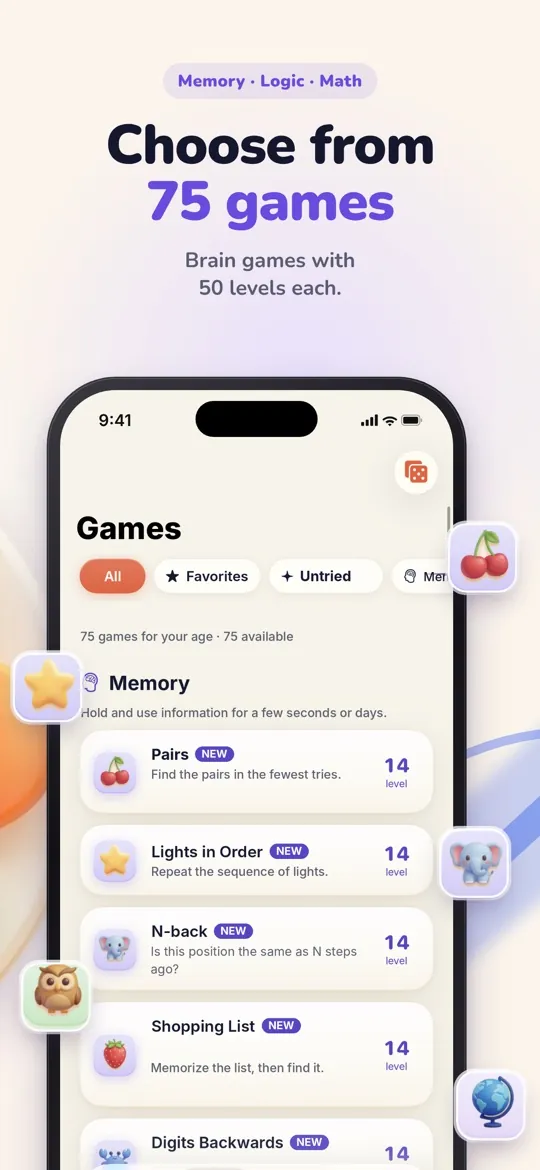
The free version allows you to practice every day; Pro offers a wider selection of games in the daily plan, as detailed in the details. Check the specific availability of n-back in your version and plan before purchasing that game. Don't confuse a promotional screenshot with a permanent guarantee of access to all features.
Variations with friends and paper
One person can read a short sequence of letters and another responds in one-back; then switch turns. Write the sequence down at the end to check your answers. Don't mix responses with criticisms of the other person's memory.
For children, use colors or shapes and a few rounds, if they already understand "the previous one" and "two before." A six-year-old can enjoy a simple pattern, but the complexity should be adjusted individually. Evidence from training in children does not allow us to promise a broad effect on school performance.
Another variation is to walk around a room and remember a sequence of objects, although this changes the task considerably. If you're interested in learning something useful, alternate n-back with a vocabulary deck or a social game. Variety can enrich leisure time without turning an activity into medicine.
Common mistakes when learning n-back
The most common mistake in 2-back is comparing with the previous turn because it's still fresh. You can imagine two small memory spaces and shift each stimulus as a new one arrives. It's also common to press the button when a familiar letter appears at any point; recount exactly N positions. Practice with five slow stimuli before increasing the speed.
Another mistake is interpreting a difficult level as a test of your memory. The task combines rhythm, rule comprehension, and motor response. If you fail several times, look at a written sequence and explain to someone else why each turn does or doesn't match. That explanation exercise can clear up the confusion without playing thirty rounds in a row.
If you play as a family, avoid comparing a child to an adult. You can enjoy a cooperative round of 1-back on paper and discuss strategies. For a genuine memory concern, note everyday difficulties and consult a professional. N-back does not replace an assessment, and a high score does not rule out a problem. The honesty of its limits allows it to be appreciated as a challenge with clear rules.
You can use the same example sequence aloud with another person and then change a single letter. Ask in which turn you should press and why. If you can both explain the answer, you've understood the rule even if you haven't won any levels. A slow game with clear rules can be more satisfying than a quick series of random presses. When you return to the app, first check if the variant uses positions, sounds, or both, because they aren't solved in exactly the same way.
Frequently Asked Questions
What does the N in n-back mean?
The number of turns back to which you compare the current stimulus.
What is the difference between 1-back and 2-back?
In 1-back you compare with the previous turn; in 2-back, with two turns before.
Does it improve intelligence?
That cannot be concluded from improvements in gameplay; widespread transfer is small or debated in research.
Is this a medical test?
No. A commercial version of n-back does not diagnose memory or attention problems.
Is it on the app?
Yes, "n-back" appears in the details and screenshots; check your plan and version access.
Sources
Reviewed November 12, 2026. n-back meta-analysis; App Store Spain; Review of commercial programs. Commercial features are taken from store listings; scientific conclusions are not the result of an evaluation of this app.