Spaced repetition: how to remember what you learn
Transparency: Brain Games is made by AppRadar, the publisher of this website.
Spaced repetition involves recalling information at various times, leaving intervals between reviews. It can organize the study of vocabulary or capitals, but it does not guarantee permanent recall nor does it replace understanding and using what has been learned.
What it is and what it's for
Spaced repetition means revisiting information at different times, rather than reading it many times in a single session. You can use it for vocabulary, capitals, or specific concepts. The key is to try to recall the information before looking at the answer and checking for mistakes. The method organizes practice; it doesn't guarantee you'll remember it forever, nor does it replace understanding what you study.
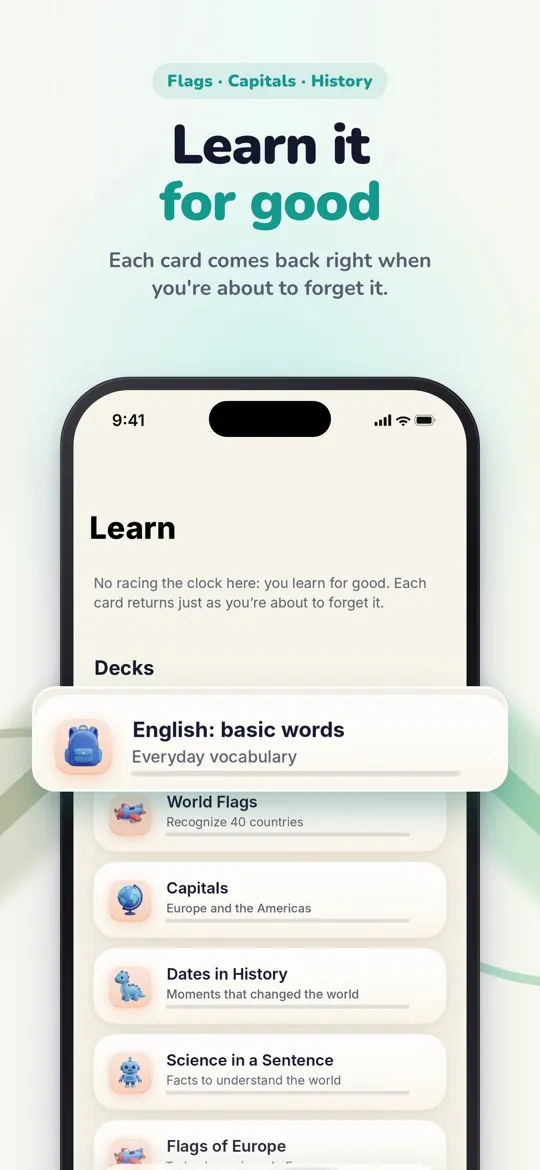
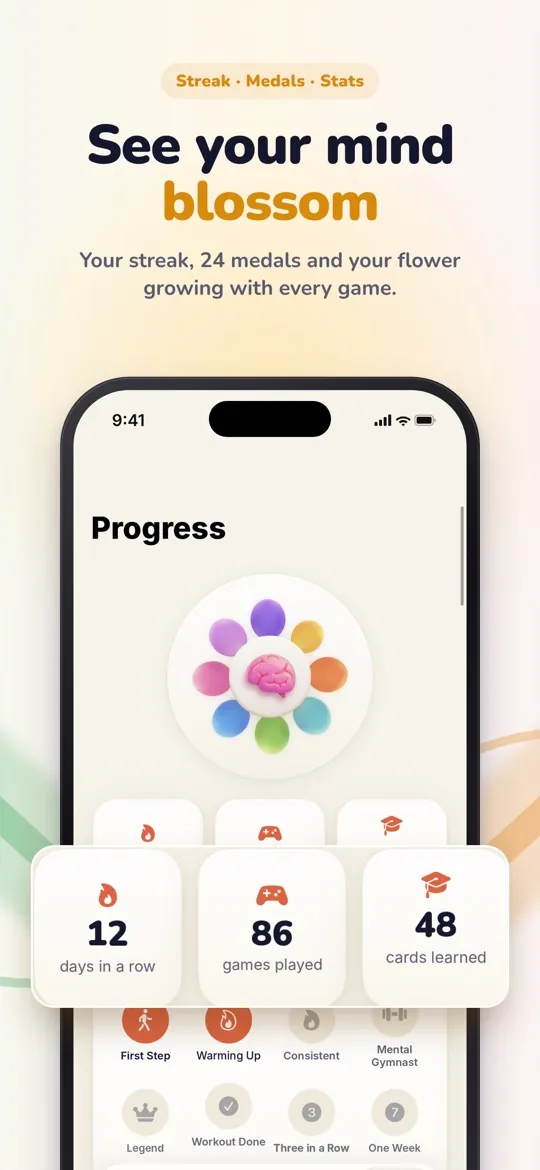
The "Learn" section of Brain Games features decks of English, flags, capitals, tables, history, and science. Its screenshots say the cards reappear when it's time to review. That description is from the product; the exact algorithm and its results have not been independently verified. A deck can help you create a routine, and you can check off-screen whether you remember and use the information.
The life cycle of a useful card
Start with a specific question and a short answer. “What is the capital of Portugal?” is a better card than “Tell me all about Europe.” Look at the question, try to recall the answer without opening the card, check, correct, and then look at it again. If you fail, it’s not a failure; it indicates that you need another attempt.
An ambiguous flashcard teaches poorly. If you ask about a flag, add the country or a clue that doesn't generate multiple answers. If you're teaching vocabulary, include pronunciation, meaning, and a sentence using it. For a historical date, relate the event to its context. An isolated answer might be recognizable within an app but couldn't be explained in a conversation.
Review the content before spending time on it: errors on a card are repeated just as often as correct answers. If the information depends on the year, add a verification date. In translations, don't assume that an English deck retains the same difficulty when changing the source language. The examples should be adapted to the learner's knowledge and culture.
Spacing without obsessing over the calendar
You can review on the same day, a few days later, and later on, letting the app remind you of what you need to review. You don't need to manually calculate intervals to take advantage of this idea. The important thing is that there's an opportunity to remember after you've forgotten something and feedback when you don't get the answer right. If you accumulate hundreds of cards, limit adding new ones to make the review process sustainable.
A missed day doesn't erase what you've learned. Focus on a manageable amount and distinguish what truly matters from a curious fact you no longer want to study. A winning streak on an app can be motivating, but it shouldn't force you to review when you're tired or sacrifice other activities.
If you're studying for a test, combine flashcards with application and explanation questions. Knowing the name of a capital city isn't understanding geography; remembering a word isn't enough to hold a conversation. The flashcard is one piece of a larger learning process.
From a response to knowledge
After correctly identifying a flag, locate the country on a map and relate it to a news story or a trip. After an English word, use it in your own sentence. After a scientific fact, explain it without the card and look for open questions. These connections make retrieving information meaningful.
A deck can alternate between recognition and free response. Recognizing one option out of four is easier than producing it without clues; don't confuse the two tasks. If the app shows only one image and you have to choose, try naming it afterward without help. A high internal score shows mastery of that task under its rules, not complete understanding of the topic.
The app also offers brain games. Keep these two functions separate: learning a capital city with a flashcard provides verifiable content; progressing in a memory game demonstrates performance in that game. Both can be enjoyable, but they don't automatically produce the same type of learning.
For children and adults
For children, choose a few cards, accompany them with conversation, and confirm that the content is appropriate for the school. If the child cannot read, an adult can show an image and talk about it; do not force the pace of a deck designed for readers. The app is presented for ages 6 to over 80 and adapts the experience, but each family should assess what material is appropriate.
For adults, set a specific goal and select a deck that interests you. Ten concepts understood and used are more valuable than one hundred cards reviewed without attention. You can study with another person to formulate different questions and discuss the context.
Everyday memory also uses external tools: calendars, notes, and alarms. Using them is a practical strategy, not a training “failure.” If you have a new or persistent concern about your daily memory, consult a professional instead of using an app as a test.
What the page should not promise
There is no formula that guarantees "learning without forgetting" in the literal sense. That promotional slogan describes the intention of scheduling reviews, not a universal result. It uses verifiable expressions: the app offers decks and presents flashcards for review; the user can practice retrieving specific information.
The NIA warns that evidence on commercial apps does not support claims of widespread cognitive improvement. Spaced repetition for studying facts is a function with a limited goal, distinct from preventing decline. Avoid mixing both messages in a call to action.
Examples of vocabulary, history, and capital cities depend on the language and cultural context. If you are studying in another language, check that you understand both the question and the explanation of the answer. You can make your own associations, look for a map, or ask someone who knows the topic. Learning is enhanced when information is connected to an idea that makes sense to you.
Design a small deck that you can keep
Start with ten cards on a single topic and check that each question has a precise answer. If a card repeatedly fails, rewrite it: perhaps it asks several things at once, uses an ambiguous term, or requires prior explanation. A short, careful review can be better than a hundred rapid keystrokes.
For vocabulary, alternate between recognizing a word and producing it within a sentence. For geography, combine map, name, and flag. For history, ask what happened and why it matters, not just the date. Flashcards are most useful when they relate to an understanding that can be explained without looking at the screen.
If you're studying with a child, let them ask some questions and explain the meaning. If the activity turns into a speed contest, remove the timer. Learning isn't the same as racking up correct answers. The deck options and repetition offered by the app are tools, and the quality of the chosen content remains crucial.
Check your recall in another way
After several reviews, close the app and write down three answers you remember. The next day, explain one idea to someone or use it in a conversation. If you only recognize the answer when you see it among the options, you may still need retrieval practice without cues. This check distinguishes the familiar "it sounds familiar" from a usable memory.
It's also valid to forget something you won't use again. Decide what information deserves to stay in your repertoire and eliminate data that no longer serves your purpose. Spaced repetition is a way to distribute effort, not an obligation to retain every fact you ever studied.
For complex subjects, solve problems and compare sources. A card that says "n-back improves intelligence" would be a bad card because it's an unsupported claim. Accuracy matters in both the content and the review algorithm. If the sources change, update the card and the date.
To conclude
If a card poses a debatable answer, check a reliable source before repeating it. Sometimes a question requires a more precise location, date, or definition. A good review tool doesn't automatically correct the content entered into it. When translating a deck, check proper names, pronunciation, and school conventions of the country. The accuracy of the questions matters as much as the review interval, and an incorrectly learned answer can be difficult to unlearn. When a fact changes, update the card and double-check the source before sharing it.
Frequently Asked Questions
What does spaced repetition mean?
Try to recall a piece of information at different times, with feedback, instead of rereading it many times at once.
Does it guarantee you'll never forget?
No. It helps organize reviews, but recall depends on the content, understanding, and practice.
What can I study in the app?
The card lists English, flags, capitals, tables, history and science, among other decks.
Does a long streak demonstrate better memory?
No. Indicates continued use of the app, not a clinical measure.
Is it suitable for an exam?
It can help with concrete data; combine it with explanations, problems, and application of knowledge.
Sources
Reviewed November 12, 2026. App Store Spain; NIA, Cognitive Health; NIA, Healthy Aging. Commercial features are from store listings; scientific conclusions are not the result of an evaluation of this app.