How to practice multiplication tables at home: a simple plan for a week
Transparency: Tablitas is made by AppRadar, the publisher of this website.
Practicing multiplication tables at home doesn't require turning every afternoon into a second school day. You can organize a short routine with a clear objective, a few operations, and a review time. The key to the plan we propose is knowing what you're going to focus on: understanding a multiplication problem, remembering an answer, or applying a table to a word problem. When that objective is defined, it's easier to choose an activity and decide when to stop.
This guide offers a sample week that you can adjust to your schoolwork and family availability. It doesn't promise you'll master all your multiplication tables in seven days. Its purpose is to help you organize your review, identify specific questions, and prepare for the following week with useful information. You can use Tablitas as part of your routine, along with a notebook, flashcards, or small objects you already have at home.
Before you begin: choose a target you can observe
“Reviewing math” leaves too many options open. A more specific objective would be “recognizing 6 × 4, 6 × 5, and 6 × 6 when they appear mixed up.” Another could be “representing four groups of seven objects.” Both are valid, but they require different activities. The first focuses on recalling results; the second, on understanding an organization of quantities.
Ask which multiplication tables they are working on in class and which operations cause the most confusion. If the child doesn't know the answer, offer three or four examples without presenting them as a major test. Listen to their thinking and note a specific observation. "They start counting from the beginning in 6 × 4" provides more information than "they struggle with the six times table."
Choose a main goal for the week and leave room to review it. If it's too easy, you can broaden the scope. If it's more difficult than expected, reduce the number of operations. The plan should serve your practice, not become an obligation that prevents you from adjusting the difficulty.
Create a recognizable opening and closing moment
Find a time when you can both focus without being preoccupied with leaving the house or finishing another task. It doesn't always have to be the exact same time. A familiar reference point might work better, like after putting away snacks or before choosing a story. The important thing is that the start is understandable and doesn't come as an unexpected interruption.
Before opening an app or taking out cards, explain what you will be doing: "Today we are going to look at three multiplication problems from the six times table." Also agree on how you will finish: a question to review what you have learned and the choice of the next step. A clear ending ensures that the activity doesn't depend on continuing to play until fatigue sets in.
You can start with a short session and extend it only if it makes sense. The durations in this article are family organization decisions, not a universal educational prescription. If the child is tired or frustrated, adapt the activity. The information you gather should help you adjust the plan, not argue about how much time is left.
The weekly plan at a glance
| Day | Objective | Proposed Activity | What to Observe |
|---|---|---|---|
| Monday | See the starting point | Represent three operations | How they interpret the groups |
| Tuesday | Connect results | Solve from a known operation | What strategy they explain |
| Wednesday | Review what has been done | Short questions in a different order | What they need to look at again |
| Thursday | Change the Format | Cards and digital practice | If you recognize the same relationship |
| Friday | Apply a table | An everyday problem | How you choose the operation |
| Saturday | Review without lengthening | A cooperative activity | What you can explain to another person |
| Sunday | Prepare for the following week | Conversation and notes | What to keep and what to adjust |
Monday: take note before adding exercises
Start with an operation they probably already know and another that might raise some questions. If you're working on the six times table, you can use 2 × 6 and 4 × 6. Ask them to make the groups with counters or to draw them. Then ask how they would find the total without counting each element individually.
Don't correct every word during the explanation. Listen to the complete idea first and then check the result. If they say that four groups of six make twenty, go back to the objects and check together how many are in each group. The purpose of this first session is to establish a starting point.
Finish by noting one operation you recognize and another that deserves further review. This selection prevents the rest of the week from becoming a series of randomly chosen exercises. The child can also participate by indicating which one they would like to solve more confidently.
Tuesday: Build a bridge from something known
Recall an operation from Monday and use a simple relationship. If you know 5 × 6 = 30, represent 6 × 6 as those same five groups plus one additional group. Ask how much needs to be added and why. Then write 30 + 6 = 36 next to the multiplication.
Give them the opportunity to come up with another similar example. They can use 5 × 4 to find 6 × 4. If the idea isn't clear, use fewer groups and go back to the drawing. It's not necessary to exhaust all the possibilities of the strategy in a single session.
At the end, ask them to complete a sentence: “To solve this multiplication problem, I used…”. They can respond in simple words. The explanation serves as a reminder for the next day and allows you to check if they followed the reasoning or just the sequence of numbers you said.
Wednesday: change the order of the questions
Present the operations practiced in a different order. You can write each one on a card and mix them up. Keep the number small to observe what happens without turning the review into a lengthy test. If they need to draw or use addition to their advantage, allow it and note it as part of their strategy.
Separate the cards into two groups: "I can explain it" and "I want to look at it again." Avoid labels that define the child, such as "I'm good" or "I'm bad." You are classifying tasks to organize practice, not permanent abilities.
Choose a card from the second group and reconstruct it together. Then finish with a familiar operation. This last question should serve to clearly conclude the activity, not to disguise what still needs practice. Both observations can be addressed in the same session.
Thursday: combine screen and paper with the same goal
You can set aside this day to use Tablitas and compare the experience with the flashcards. The app's website offers a short practice exercise that focuses on difficult multiplications and allows the family to monitor progress. View Tablitas. The purpose of this guide is to complement that use with a simple off-screen check.
Before you begin, remember which operation you are working on. When you finish, write a related question in your notebook. If you have seen 6 × 4 during the session, you can draw four groups of six or pose 4 × 6. The aim is to observe whether the student recognizes the relationship when the presentation changes.
Not all answers need to be immediate. If you need to reconstruct the calculation, listen to how they do it. That information can guide you better on Friday than a general impression of how much they played. You can check the download conditions on Google Play or App Store.
Friday: apply multiplication to an everyday situation
Pose a short, concrete problem: “We have six bags and we want to put four cards in each one. How many cards do we need?” Let them draw, manipulate objects, or write the problem directly. Ask what each number represents before checking the answer.
If they give a different sum, review the problem statement. Perhaps they understood that there are six cards in total or that the bags contain different amounts. Clarifying the situation is part of the process. Don't interpret any difficulty with the text as a conclusion about their memorization of multiplication tables.
Then change one piece of information while keeping the structure: five bags with four cards. Ask what changes in the total. This small adjustment allows you to compare two operations without introducing a completely new story. Keep the language simple so the focus remains on the quantities.
Saturday: Prepare a cooperative activity
You can organize a matching game between operation cards and result cards. Each time you find a match, one person explains how they could check it. If siblings of different ages are participating, assign different roles: one represents the groups and the other writes the operation.
Another option is to set up a small, imaginary shop. Each package contains a fixed number of items, and you should calculate the contents of several packages. Use numbers related to your weekly goal. There's no need to add money if that introduces operations you don't yet want to practice.
The cooperative nature of the activity allows conversation to take precedence over winning. If someone makes a mistake, you can check the number together. The outcome of the activity is a collection of understood examples, not a ranking of participants.
Sunday: Decide what deserves another week
Review the notes without turning it into a formal assessment. Ask which activity was clearest, which was most difficult, and which multiplication problem they want to continue practicing. You can retrieve a card from Monday to see how they approach it now, without demanding that the answer demonstrate a specific improvement.
Write down a decision for the following week: keep the table, combine it with another one, or work on written problems. If you don't know what to choose, go back to the initial objective. Did you want to understand groups, remember results, or apply an operation? The answer helps interpret the observations without changing your approach at the end.
If persistent difficulties or discomfort arise that complicates practice, share specific examples with the teacher. A description of what is happening allows for better coordination of support than a general label. Home routines can complement learning without assuming the role of a professional assessment.
A family record that doesn't become another chore
You can use four columns on a sheet: date, operation, strategy, and next step. An entry might say: "Tuesday; 6 × 6; use 5 × 6 and add six; repeat mixed up." You don't need to record every answer or time every activity.
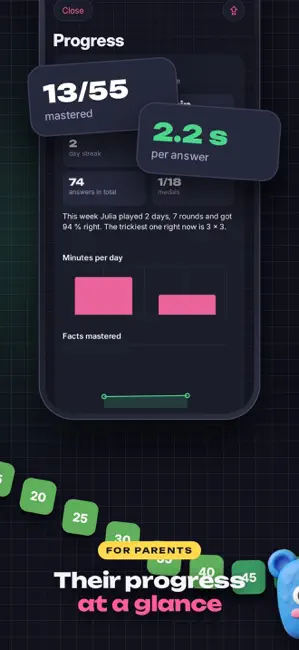
The Tablitas iOS app description includes a family section with information about errors, times, and progress. Check what your version includes before relying on a specific feature. See the description on the App Store. If you already have useful information within a tool, avoid duplicating it unnecessarily; reserve the notebook for notes you want to remember.
Frequently Asked Questions
How many days a week should we practice our multiplication tables?
This plan offers seven possible times, but you can adapt it to your availability. It's not a daily obligation or a guarantee of learning. Prioritize activities with a clear objective and check how the child responds before increasing the frequency.
What happens if we can't practice one day?
Revisit the goal next time without accumulating exercises as automatic compensation. You can start with a familiar question to get back on track and continue from there. The calendar should help you organize, not add to your to-do list.
Is it advisable to always repeat the same table?
You can focus on one table when entering it and then combine it with familiar operations. If you mix too many new things at once, it will be harder to identify what needs support. Adjust the mix based on what you observe in the responses and explanations.
Can I use Tablitas every day of the plan?
You can incorporate it when it fits with the objective and the usage conditions decided by your family. Also, maintain opportunities to demonstrate and explain operations off-screen. The app is one resource within the plan, not the only possible format.
How do I know if I'm progressing without taking a test?
Observe whether they recognize an operation they previously reconstructed from scratch, whether they explain a strategy, or whether they solve a problem with equal groups. Compare specific examples at different times. Usage time alone does not answer that question.
Is it advisable to reward each correct answer?
You can acknowledge the effort involved in explaining, checking, and correcting, in addition to the result. Before introducing external rewards, decide what behavior you want to encourage. Avoid making the sole purpose of the activity to be achieving something by completing a certain number of questions.
Prepare your next session
Choose three operations, one material, and one closing question. This will allow you to start your plan and adjust it later. If you need to work on comprehension, see how to learn the tables step by step. If the difficulties are concentrated in specific operations, continue with the guide to the seven, eight, and nine times tables.